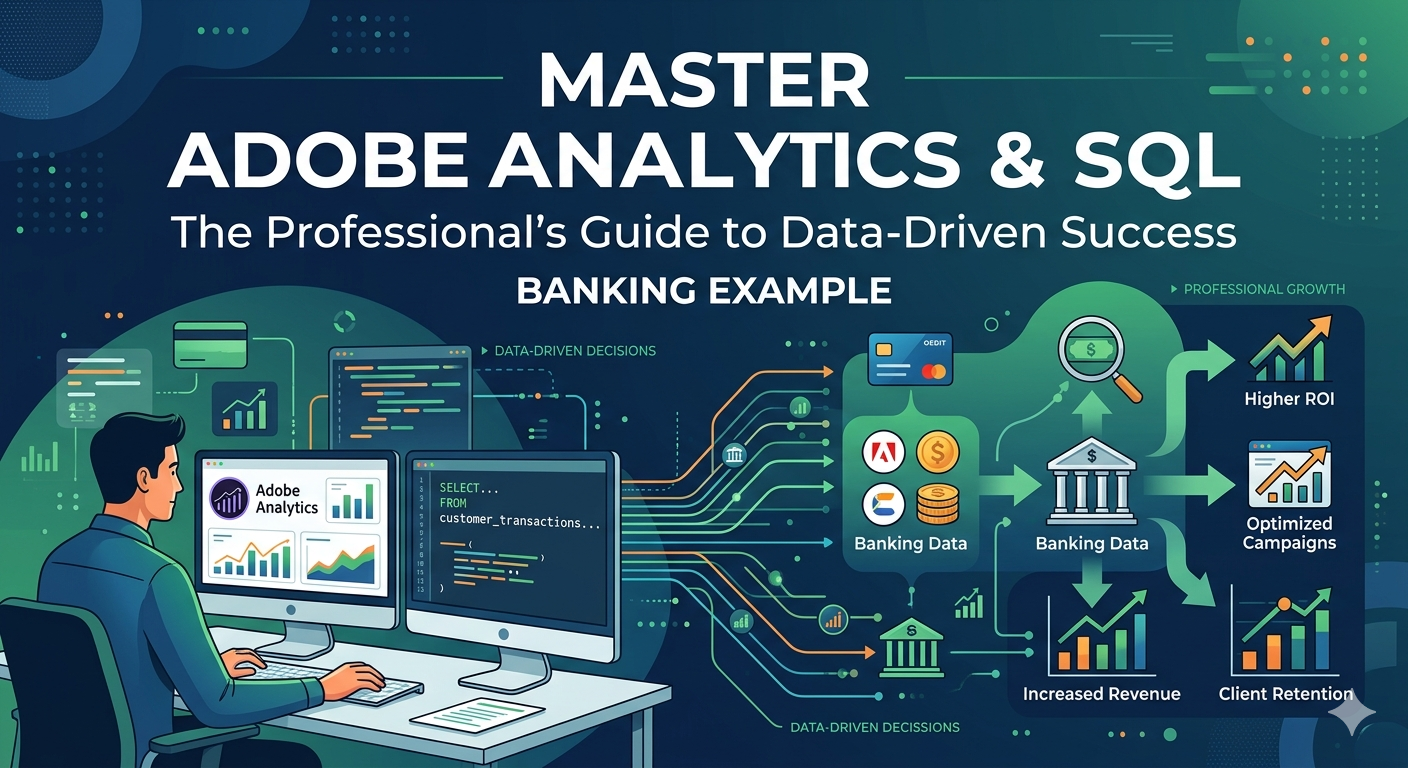
Master Adobe Analytics & SQL: The Professional’s Guide to Data-Driven Analytics Success

Becoming a master in digital analytics especially with Adobe Analytics and SQL isn’t about memorizing buttons or queries. It’s about building a deep, practical understanding of how data flows, how insights are born, and how to turn complexity into clarity. This guide cuts through the noise to focus on what truly matters: architecture, technical execution, and professional mastery.

Whether you’re refining your skills or leveling up your expertise, these fundamentals will anchor your journey.

🔑 Core Definitions Every Analytics Professional Should Know

  • Adobe Analytics Architecture: The structured framework of data collection (tags, variables, processing rules), data storage (report suites, data feeds), and data activation (segments, alerts, integrations) that powers insight generation.
  • SQL for Analytics: Using Structured Query Language to extract, clean, join, and analyze raw analytics data—enabling custom analysis beyond native reporting tools.
  • Implementation Governance: The ongoing practice of documenting, testing, and maintaining your analytics setup to ensure data accuracy, consistency, and scalability over time.
  • Data Layer Strategy: A standardized method for passing structured data from your website or app to analytics tools, ensuring reliable, repeatable tracking across teams and platforms.
  • Attribution Intelligence: Moving beyond default models to understand how different touchpoints contribute to outcomes—and knowing when to apply which model for business decisions.
  • Cross-Platform Identity: Techniques for recognizing users across devices and channels (using IDs, cookies, server-side stitching) to create a unified view of behavior.

🧱 Pillars of Adobe Analytics Mastery

1. Architecture First, Tools Second

True mastery starts with understanding how Adobe Analytics is built:

  • Report Suites & Global Configs: Know when to segment data at the collection level vs. the reporting level.
  • Processing Rules & VISTA: Leverage server-side rules to clean, enrich, or standardize data before it hits reports—reducing manual fixes later.
  • Data Feeds & Warehouse: Use raw hit-level exports for deep-dive analysis, anomaly detection, or feeding machine learning models.
  • Extension & Tag Management: Implement cleanly via Adobe Launch (now Tags) to ensure flexibility, version control, and team collaboration.

2. SQL: Your Analytics Superpower

Native reports answer “what.” SQL helps you answer “why” and “what if”:

  • Hit-Level Analysis: Query individual interactions to debug tracking issues or map micro-conversions.
  • Custom Cohorts: Build behavioural segments SQL can’t create in the UI (e.g., “users who viewed product X, abandoned cart, then returned via email”).
  • Data Blending: Join Adobe data with CRM, ad platform, or operational data for holistic insights.
  • Automation: Schedule SQL scripts to refresh dashboards, alert on anomalies, or feed executive reports.

💡 Pro Practice: Always document your SQL logic. Future-you (and your teammates) will thank you.

3. Integrations That Drive Action

Analytics doesn’t live in a vacuum. Mastery means connecting systems purposefully:

  • CRM Syncs: Pass anonymous behavioral data to Salesforce or Marketo to trigger personalized journeys—while respecting privacy.
  • Paid Media Feedback Loops: Use Adobe conversion data to optimize bids in Google Ads or Meta via offline conversion imports.
  • CDP & Data Clouds: Feed cleaned Adobe audiences into customer data platforms for activation across email, ads, and web.
  • Validation Frameworks: Build automated checks (e.g., “daily event count variance <5%”) to catch integration drift early.

4. Reporting with Purpose

Great reporting isn’t about more charts—it’s about clearer decisions:

  • Start with the Question: “What decision will this report inform?” If you can’t answer, rethink the report.
  • Segment Relentlessly: Aggregate data hides truth. Slice by device, channel, user type, or behavior to uncover actionable patterns.
  • Visualize for Impact: Use annotations, benchmarks, and trend lines to highlight what matters—not just what changed.
  • Document Assumptions: Note attribution windows, segment logic, and data latency so stakeholders interpret insights correctly.

🛠️ Implementation Excellence: The Professional’s Checklist

Pre-Launch

  • Map every variable to a business question
  • Test in staging with real user flows
  • Validate data layer consistency across pages

Post-Launch

  • Monitor data quality dashboards daily for the first week
  • Reconcile key metrics against source systems weekly
  • Document changes in a shared implementation log

Ongoing

  • Review variable usage quarterly—deprecate what’s unused
  • Train teammates on segmentation and analysis basics
  • Stay updated on Adobe releases and SQL best practices

🌱 Mindset of an Analytics Professional

Mastery isn’t a destination—it’s a practice. Cultivate these habits:

  • Curiosity Over Certainty: Ask “What else could explain this pattern?” before settling on an answer.
  • Clarity Over Complexity: If you can’t explain it simply, you don’t understand it well enough.
  • Ethics Over Expediency: Respect user privacy, data governance, and transparent reporting—even when no one’s watching.
  • Collaboration Over Silos: Share insights, document processes, and uplift your team. Great analytics is a team sport.

📚 Your Next Step: Deep Practice

Theory becomes mastery through deliberate application. To solidify your expertise:

  1. Recreate a report using both Adobe UI and SQL—compare results and note discrepancies.
  2. Audit one integration (e.g., Adobe → CRM) end-to-end: data flow, mapping, validation, and business use.
  3. Teach one concept (e.g., eVar allocation) to a colleague. Teaching reveals gaps in your own understanding.

Final Thought: Becoming a true analytics professional means blending technical depth with strategic thinking. It’s about building systems that last, insights that matter, and trust that endures. Keep learning. Keep questioning. Keep connecting data to human outcomes.

Find below the questions. Thoroughly go through them, study, and good luck.

(Nordic Bank Approach As Example)

To ground these concepts in practice, the Q&A sections below apply Adobe Analytics and SQL mastery to typical challenges faced in Nordic Bank’s digital analytics ecosystem

Adobe Analytics · SQL · Integrations — 60 Expert Q&A
⚡ Advanced Technical Mastery

Adobe Analytics · SQL
Platform Integrations & Reporting

60 deep-dive questions covering Adobe Analytics architecture, SQL for analytics, CRM/paid media integrations, reporting, and practical banking case studies — a completely separate companion guide.

Adobe Analytics SQL & Data Feeds Google Ads Integration Salesforce CRM AEP / CDP Reporting & Workspace
60Questions
4Focus Areas
12+Case Studies
20+Code Examples
🅰️

Adobe Analytics — Architecture, Variables & Implementation

Core platform internals, eVars, props, events, processing, and SDK architecture

Q1 – Q22
1
Explain the complete Adobe Analytics data collection architecture — from user action to Analysis Workspace.
ConceptArchitecture
Understanding the full pipeline is essential for diagnosing issues at any layer.
User Action
Click / Page View
Data Layer
window.dataLayer
AEP Tags Rule
if/then logic
AA Extension
maps vars
Image Request
/b/ss/rsid
Edge Network
Adobe DC
Processing
Rules / VISTA
Report Suite
Storage
Workspace
Query
  • Image Request (beacon): A 1×1 pixel image request to b/ss/{rsid}/1 carrying all variable data as query parameters — e.g. ?pageName=mortgage:calculator&v1=email-campaign&events=event1
  • Web SDK (modern): Sends XDM-formatted JSON to the AEP Edge Network via POST. Edge processes and forwards to Analytics, Target, and other destinations simultaneously.
  • Processing layer: VISTA rules run first (server-side, complex), then Processing Rules (admin-managed, simpler), then Marketing Channel rules, then Classifications.
  • Report Suite: Data is stored at hit level. Workspace queries aggregate in real time — this is why complex queries on large date ranges can be slower.
💡 Banking tip: In a Nordic bank context, the Edge Network’s EU-based data centres ensure data does not leave the EEA — critical for GDPR compliance with Finnish financial regulation.
2
What is the difference between context data variables and eVars/props? When should you use each?
ConceptImplementation
Context Data Variables
Intermediate key-value pairs sent in the beacon that are NOT stored directly — they must be mapped to eVars/events via Processing Rules.

e.g. s.contextData["product.type"] = "mortgage"

Why use them: Clean separation between data layer and reporting configuration. Developers only send data — analytics team controls how it maps in the admin UI without code deployment.
eVars / Props / Events
The actual reporting variables. Data must end up here to appear in reports.

eVar5 = Product Type → shows up in Workspace dimension.

Mapping via Processing Rule: “If context_data[product.type] exists → set eVar5 equal to context_data[product.type]
AppMeasurement.js // Modern approach: context data → mapped via Processing Rules s.contextData[“page.name”] = “mortgage:calculator”; s.contextData[“user.loginStatus”] = “authenticated”; s.contextData[“form.step”] = “3”; s.contextData[“form.event”] = “step_complete”; s.t(); // send beacon // Processing Rule: IF contextData[form.event] = “step_complete” // THEN set event5 (form step completion) // AND copy contextData[form.step] to eVar12
3
How do eVar expiration and allocation settings work? Demonstrate with a banking loan application example.
TechnicalCase Study
Expiration controls how long an eVar value persists and can be credited for a conversion. Allocation controls which value gets credit when multiple values are set before a conversion.
Expiration Options
Hit: Value clears after one hit (like a prop)
Visit: Clears at end of session
Visitor: Persists across all visits until changed
Time-based: e.g. 30 days, 90 days, 1 year
Custom event: Clears when a specific event fires
Allocation Options
Most Recent (Last): The last value set before conversion wins
Original Value (First): The first value ever set wins
Linear: Credit distributed equally across all values
Banking example — Campaign eVar:
  • User clicks paid search ad → eVar1 = “google-cpc-mortgage” (Visit 1)
  • Returns 3 weeks later from email → eVar1 = “email-mortgage-reminder” (Visit 2)
  • Returns 2 days later directly → completes application (Visit 3)
With Most Recent + 90-day expiration: email gets full credit (last channel before conversion).
With Original Value + 90-day expiration: paid search gets full credit (first acquisition channel).
With Linear + 90-day expiration: each channel gets ~33% credit.
💡 The “right” setting depends on your business question. Use Attribution IQ in Workspace to compare models without changing the eVar setting.
4
How do you implement and use List Variables (List Props and List eVars) in Adobe Analytics?
TechnicalImplementation
Standard eVars and props hold a single value. List variables hold multiple delimited values simultaneously — useful for multi-value dimensions.
List Props
Hit-scoped. Multiple values delimited by a configurable separator. Each value receives the metric count independently.

e.g. Content categories on a page: s.prop1 = "mortgage;savings;calculator"
List eVars
Conversion-scoped. Persist like regular eVars. Each value receives credit for subsequent conversions proportionally.

e.g. All products a user browsed before converting: s.eVar7 = "mortgage,savings,loan"
Banking Use Case // Track all product categories viewed in a session // before a customer submits an application s.eVar7 = “mortgage,savings,rate-comparison”; // List eVar, delim=”,” // When application completes (event1 fires): // Workspace can show: mortgage → X applications // savings → X applications // rate-comparison → X applications // One conversion counted for ALL three simultaneously
Use List eVars to answer: “Which product categories in a session correlate most strongly with eventual loan applications?” This informs content strategy without needing complex SQL joins.
5
What are Adobe Analytics Data Feeds and how do you use them for advanced analysis?
TechnicalData Engineering
Data Feeds export raw, hit-level data from Adobe Analytics to an external storage location (S3, Azure Blob, SFTP) as compressed TSV files. This is the most granular data Adobe provides — every single beacon that was sent.
Key Columns Available
post_evar1..250 — post-processing eVar values
post_event_list — events that fired on the hit
visit_num — visit number for visitor
hit_time_gmt — Unix timestamp
page_url, referrer — page and referrer
post_campaign — campaign tracking code
mcvisid — Marketing Cloud visitor ID
Why Use Data Feeds Over Workspace?
✓ Unsampled data regardless of date range
✓ Build custom attribution models in SQL
✓ Join with CRM, call centre, offline data
✓ Cohort analysis with exact session sequences
✓ Feed into ML models and predictive scoring
✓ Long-term historical storage beyond Adobe retention
BigQuery — Load Data Feed — Load Data Feed TSV into BigQuery LOAD DATA INTO `project.dataset.aa_hits` FROM FILES ( format = ‘CSV’, field_delimiter = ‘\t’, uris = [‘gs://aa-feeds/2025-01-01/*.tsv.gz’] ); — Example query: sessions that touched mortgage page — then completed an application SELECT post_campaign, COUNT(DISTINCT visid_high || visid_low) AS converters FROM `project.dataset.aa_hits` WHERE DATE(TIMESTAMP_SECONDS(hit_time_gmt)) = ‘2025-01-01’ AND post_evar1 = ‘mortgage’ AND CONTAINS_SUBSTR(post_event_list, ‘event1’) GROUP BY 1 ORDER BY 2 DESC;
6
Walk through a real scenario: a loan application tracking break was discovered. How do you diagnose and fix it end-to-end?
Case StudyDebugging
🔍
Case Study — Tracking Break
Nordic Bank: Loan Application Event 1 Drop 65% Overnight
On Monday morning, the weekly dashboard shows event1 (loan application complete) dropped from 140 to 49 — no change in traffic or starts. CRM shows normal completion volume. The tracking is broken, not the product.
  1. Confirm it’s tracking, not real: Cross-reference CRM completions. If CRM shows 140 completions but AA shows 49, it’s a tracking break. If both show 49, it may be real.
  2. Check the deploy log: Was a site release pushed over the weekend? Look for changes to the application confirmation page or any step 5 code.
  3. Open Adobe Debugger on confirmation page: Walk through a test application. Does event1 fire on the confirmation page? Check exact variable values — is the page even reaching the tag rule?
  4. Inspect the data layer: Open browser console → inspect window.dataLayer on confirmation page. Is the expected object present? Has the object structure changed after the deploy?
  5. Check AEP Tags rule: Open Tags → Staging environment → find the Application Complete rule → verify the trigger condition is still valid. A common break: developer renamed a CSS class or changed a URL pattern that the rule condition was matching on.
  6. Reproduce and fix: In dev environment, replicate the fix (e.g. update rule condition or data layer key name). Test in staging, validate with Debugger, get sign-off, deploy to production.
  7. Backfill estimate: Use CRM data to estimate actual completions during the broken window. Note data gap in dashboards and reports.
  8. Post-mortem and prevention: Add synthetic monitoring — automated script that runs through the application journey daily and alerts if event1 doesn’t fire.
7
How do you configure Adobe Analytics Marketing Channels, and what are the most common mistakes?
ConfigurationTechnical
Marketing Channels in Adobe Analytics classify each visit’s entry touchpoint. Rules are processed in priority order — first match wins.
PriorityChannelRule LogicCommon Pitfall
1InternalReferrer domain = bank.fiMust be first or internal traffic inflates Direct
2Paid Searchutm_medium = cpc AND search engine in sourceMissing branded keywords → falls to Organic
3Paid Socialutm_medium = paid-socialInconsistent UTM values across teams
4Emailutm_medium = emailEmail tool not using UTMs → lands in Direct
5Displayutm_medium = display OR cpmProgrammatic uses different medium values
6Organic SearchReferrer = search engine AND no UTMsToo-broad rule steals paid traffic
7DirectNo referrer AND no UTMCatch-all — should be small if UTMs are complete
⚠️ Most critical mistake: Not excluding internal domains first. If a customer visits from paid search, navigates the site, then clicks a mortgage CTA — without internal exclusion, the CTA click registers as a new “Direct” session, stealing credit from paid search.
8
How does Adobe Analytics handle identity — what is the ECID and how does cross-device tracking work?
ConceptIdentity
ECID (Experience Cloud ID)
The primary identifier used across all Adobe Experience Cloud solutions. Stored as a first-party cookie (AMCV_). Persists across visits on the same device/browser. Generated by the Identity Service and shared across Analytics, Target, Audience Manager.
Visitor ID Hierarchy
Adobe resolves identity in this priority:
1. Custom Visitor ID (your own hashed user ID)
2. ECID (Adobe’s first-party cookie)
3. Legacy cookies (s_vi, s_fid)
4. IP+User Agent fallback (last resort)
Cross-device tracking in banking context:
  • When a user logs into online banking, fire a custom visitor ID: s.visitorID = SHA256(hashedCRMId)
  • This stitches mobile app session, web session, and logged-in session under one persistent ID (with consent)
  • In AEP, this is handled via Identity Namespaces — ECID, hashed email, CRM ID are all linked in the Identity Graph
  • Privacy consideration: You must have explicit consent and document the lawful basis for linking cross-device identities
ITP (Apple’s Intelligent Tracking Prevention) limits first-party cookie lifetime to 7 days on Safari when set via JavaScript. Server-side cookie setting via CNAME or first-party data collection extends this — critical for Nordic markets with high iPhone usage.
9
What is Virtual Report Suite (VRS) in Adobe Analytics and when would you use one?
ConceptConfiguration
A Virtual Report Suite is a filtered, segmented view of a parent report suite — no extra data collection, no extra cost, just a curated lens.
When to Use
Different teams need different scopes — mortgage team sees only mortgage pages, Finnish team sees only FI market data.
Access Control
Grant product managers or regional analysts access to only their relevant data without exposing the full dataset.
Processing Time Reports
VRS supports “report time processing” — segments can be applied retroactively, changing how data appears without re-processing raw data.
Banking use case: A Nordic bank has one global report suite. Create VRS per country (FI, SE, NO, DK) using a country eVar as the segment. Each country analyst accesses their VRS — they see their data, pre-filtered, with no risk of accidentally querying across all markets.
✅ VRS with Report Time Processing is powerful — you can apply new segment definitions retroactively to historical data. A regular report suite applies segments only going forward. This is critical when measurement requirements change mid-year.
10
How do you use Adobe Analytics API (2.0) to build automated reporting pipelines?
TechnicalImplementation
The Adobe Analytics 2.0 API (Reporting API) allows programmatic querying of any report you could build in Workspace.
Python — AA API Reporting Pipeline import requests, json, pandas as pd from datetime import datetime, timedelta ## ── Step 1: Authenticate (Service Account / OAuth) ── def get_access_token(client_id, client_secret, org_id): resp = requests.post( “https://ims-na1.adobelogin.com/ims/token/v3”, data={“grant_type”: “client_credentials”, “client_id”: client_id, “client_secret”: client_secret, “scope”: “openid,AdobeID,read_organizations,additional_info.projectedProductContext”} ) return resp.json()[“access_token”] ## ── Step 2: Build Report Payload ── yesterday = (datetime.now() – timedelta(1)).strftime(“%Y-%m-%d”) payload = { “rsid”: “nordea-fi-prod”, “globalFilters”: [{ “type”: “dateRange”, “dateRange”: f“{yesterday}/{yesterday}” }], “metricContainer”: {“metrics”: [ {“columnId”: “sessions”, “id”: “metrics/visits”}, {“columnId”: “completions”, “id”: “metrics/event1”}, {“columnId”: “starts”, “id”: “metrics/event2”} ]}, “dimension”: “variables/evar1”, # Campaign “settings”: {“limit”: 50, “page”: 0} } ## ── Step 3: Execute and Parse ── headers = {“Authorization”: f“Bearer {token}”, “x-api-key”: CLIENT_ID, “x-proxy-global-company-id”: COMPANY_ID} resp = requests.post( “https://analytics.adobe.io/api/{company}/reports”, headers=headers, json=payload ) rows = resp.json()[“rows”] df = pd.DataFrame([{“campaign”: r[“value”], **dict(zip([“sessions”,“completions”,“starts”], r[“data”]))} for r in rows]) df[“completion_rate”] = (df[“completions”] / df[“starts”] * 100).round(1) df.to_csv(f“campaign_report_{yesterday}.csv”, index=False)
11
How do you design and implement a comprehensive data layer schema for a full digital banking website?
ImplementationCase Study
Data Layer Schema — Nordic Bank /** * Nordic Bank Data Layer v2.0 * Owner: Digital Analytics Team * All PII fields must remain undefined or hashed */ window.nordea_dl = { // ── PAGE CONTEXT ── page: { name: “mortgage:calculator”, // hierarchy:subpage type: “product”, // home|product|content|service|auth section: “mortgage”, language: “fi”, // ISO 639-1 country: “FI”, // ISO 3166 environment: “production” // development|staging|production }, // ── USER CONTEXT ── user: { loginStatus: “authenticated”, // authenticated|anonymous customerType: “existing”, // new|existing|prospect segment: “high-value”, // internal segment, no PII hashedId: “sha256:a3f8…c12d”, // hashed CRM ID — NEVER raw ID deviceType: “mobile” // mobile|tablet|desktop }, // ── PRODUCT CONTEXT (set on product pages) ── product: { name: “mortgage”, type: “fixed-rate”, market: “FI” }, // ── EVENT PAYLOAD (set on interactions) ── event: { name: “calculator_complete”, // snake_case event names category: “form”, // form|navigation|media|cta loanAmount: “200000-250000”, // anonymised RANGE not exact loanTerm: “25”, // years timestamp: 1735689600 // Unix ms }, // ── CAMPAIGN (populated from UTM params on landing) ── campaign: { source: “google”, medium: “cpc”, name: “2025-03_mortgage_fi_acquisition” } };
⚠️ Never store exact financial amounts, account numbers, or personal identifiers in the data layer. Use ranges (200000–250000) instead of exact values, and always use hashed IDs. This is both a GDPR requirement and a banking regulatory requirement.
12
How does Adobe Target integrate with Adobe Analytics (A4T) and what does it enable?
ConceptIntegration
Analytics for Target (A4T) is the integration that makes Adobe Analytics the reporting source for A/B tests and personalisation activities run in Adobe Target — instead of Target’s own limited reporting.
Without A4T
Target reports on its own success metrics only. Limited segmentation. Can’t use Adobe Analytics segments. Can’t apply Attribution IQ. Separate data silo from your main analytics.
With A4T
Target activity data flows into Analytics. Full Workspace analysis of test results. Use any AA segment on test data. Apply any attribution model. Consistent with all other reporting.
  • How it works: When Target serves an experience, it fires a supplemental Analytics beacon that sets a Target activity eVar and the variant info
  • Reporting: In Workspace, use the “Target Activities” dimension → breakdown by variant → compare your chosen success metric (application completion rate)
  • Segmentation power: “Show me test results ONLY for mobile users who came from paid search” — impossible in Target alone, easy with A4T in Workspace
  • Banking use case: Test personalised mortgage homepage for high-intent segment vs default → measure application start rate in Analytics → same data, same tool, same definitions
13
What is Adobe Audience Manager (AAM) and how does it relate to Adobe Analytics and AEP?
Concept
Adobe Audience Manager (AAM)
Adobe’s legacy DMP (Data Management Platform). Aggregates first, second, and third-party audience data. Creates segments for advertising activation. Integrates with Analytics via server-side forwarding.
AEP (Modern Replacement)
Adobe now recommends AEP Real-Time CDP over AAM for new implementations. AEP offers real-time profile, identity resolution, and is privacy-by-design. AAM is in maintenance mode.
Server-side forwarding (SSF) — Analytics → AAM:
  • Analytics data can be forwarded to AAM in real time without additional tag on the page
  • AAM can then enrich profiles with third-party data and create activation segments
  • Those segments feed back into Analytics as audience dimensions for reporting
💡 For new analytics implementations in 2024+, focus on AEP over AAM. Demonstrating awareness of this evolution and knowing the migration path from AAM to AEP Real-Time CDP is a strong differentiator in interviews.
14
How do you configure and use Classifications in Adobe Analytics at scale using the Rule Builder?
ConfigurationTechnical
At scale with hundreds of campaigns, manually uploading classification CSV files is unmanageable. The Classification Rule Builder applies regex or contains logic automatically to classify new values as they arrive.
Classification Rule Builder — Campaign eVar Enrichment /* eVar1 contains raw campaign IDs like: 2025-03_mortgage_fi_acquisition We want to enrich with: Product, Market, Objective, Quarter */ Rule 1: Extract Product Condition: eVar1 MATCHES REGEX ^[0-9]{4}-[0-9]{2}_(\w+)_ Output: Classification “Product” = $1 /* captures group 1 */ Example: “2025-03_mortgage_fi_acquisition” → Product = “mortgage” Rule 2: Extract Market Condition: eVar1 MATCHES REGEX _([a-z]{2})_ Output: Classification “Market” = $1 Example: → Market = “fi” Rule 3: Extract Quarter from Date Condition: eVar1 STARTS WITH 2025-0 Output: Classification “Quarter” = “Q1 2025” /* Now Workspace can filter/break down by Product, Market, Quarter */ /* without changing any tagging — just classification rules */
✅ Combine Rule Builder with a UTM taxonomy document. When the taxonomy follows a strict pattern, regex rules classify every new campaign automatically — zero manual work per campaign launch.
15
What is the Adobe Analytics Data Privacy API and how does it support GDPR right-to-erasure requests?
ConfigurationPrivacy
The Data Privacy API (GDPR API) allows programmatic submission of access and delete requests against Adobe Analytics data — fulfilling GDPR Articles 15 (access) and 17 (erasure).
GDPR Deletion Request via API # POST to: https://platform.adobe.io/data/foundation/privacy/jobs payload = { “companyContexts”: [{ “namespace”: “imsOrgID”, “value”: “YOUR_IMS_ORG@AdobeOrg” }], “users”: [{ “key”: “user_123”, “action”: [“delete”], # or “access” “userIDs”: [{ “namespace”: “ECID”, # or custom namespace “type”: “standard”, “value”: “38400000-8cf0-11bd-b23e-10b96e40000d” }] }], “include”: [“Analytics”], “regulation”: “gdpr” }
  • Identify the user: You need the ECID or custom visitor ID tied to the user. This is why linking analytics IDs to consent records is important.
  • Delete scope: Adobe deletes the visitor’s data from all report suites and from Data Feeds
  • Timeline: Adobe processes erasure requests within 30 days as required by GDPR
  • Automation: Build an automated pipeline that receives erasure requests from your DPO system and submits them to Adobe’s API within the required timeframe
16
How does Report Builder (Excel plugin) work and what are its best uses?
TechnicalReporting
Report Builder is an Excel add-in that connects directly to Adobe Analytics and allows building customised report requests within Excel spreadsheets, with automatic scheduled refresh.
  • Best use cases: Finance-style reporting where stakeholders live in Excel; combining AA data with CRM export data in one spreadsheet; complex row-by-row calculations not possible in Workspace; scheduled distribution to leadership via email
  • Data Requests: Each request is a configured query (date range, segments, dimensions, metrics) mapped to specific cells. Multiple requests per workbook.
  • Scheduled delivery: Set workbooks to refresh and send automatically — e.g. weekly loan funnel report delivered to CFO every Monday 8am
  • Limitation: Not real-time, harder to maintain than Workspace, requires Excel on Windows. Being superseded by Workspace + scheduled PDF exports for most use cases.
💡 In Nordic banking, finance teams and senior management often prefer Excel-based reports. Report Builder is the bridge between analytics and financial reporting workflows.
17
What is Anomaly Detection in Adobe Analytics and how do you configure meaningful alerts?
TechnicalConfiguration
Anomaly Detection in Analysis Workspace uses time-series decomposition (seasonal + trend + residual) to automatically identify data points that fall outside expected statistical bounds.
How It Works
Adobe calculates an expected value and upper/lower bounds for each data point based on historical patterns. Anomalies (grey shaded areas) appear automatically on line charts. The algorithm accounts for day-of-week, weekly, and monthly seasonality.
Intelligent Alerts Configuration
• Trigger: % change vs expected OR absolute threshold
• Frequency: Hourly, daily, weekly
• Delivery: Email and/or SMS
• Scope: Apply to any metric with any segment filter
Banking alert examples:
  • Alert if loan application completions drop >30% vs 7-day average (tracking break signal)
  • Alert if paid search CPA rises >25% vs prior week (budget waste signal)
  • Alert if mobile error rate exceeds 5% of sessions (UX issue signal)
  • Alert if page load time (custom metric) exceeds 4 seconds average (performance signal)
18
Practical case study: How did you use Adobe Analytics to analyse content performance and connect it to mortgage applications?
Case StudyAnalysis
📰
Case Study — Content ROI
200+ Financial Education Articles: Are They Driving Applications?
The content team had published 200+ educational articles. Leadership questioned whether to continue the investment. The challenge: content value is indirect — articles drive awareness, not direct clicks to application.
  1. Define “value” behaviorally: Not page views. Define content value as: article reader who starts an application within 30 days.
  2. Create an Adobe Analytics segment: “Visitors who viewed ≥2 education articles during their visit” using Visit Container with page category = “education” and count ≥ 2.
  3. Build a cohort in Workspace: Use the Retention Table panel. Cohort: users who engaged with content in week 1. Return metric: application start event. Measure over 4 weeks.
  4. Compare conversion rates: Content-engaged segment vs non-content-engaged segment using Segment Comparison panel. Result: 2.3× higher application rate for content-engaged users.
  5. Calculator analysis: Separate segment for mortgage calculator users. Result: 41% higher probability of mortgage application within 30 days.
  6. Business recommendation: Prioritise SEO investment for calculator and top-converting articles. Add contextual CTAs within high-converting content. Reallocate 30% of content budget to conversion-optimised pieces.
Result: Content investment was retained and expanded. Calculator redesign added to Q2 roadmap. This analysis connected content marketing spend directly to loan revenue — demonstrating that analytics creates strategic, not just operational, value.
19
How do you use Contribution Analysis (Intelligent Alerts advanced feature) in Adobe Analytics?
TechnicalAI
Contribution Analysis is an Adobe Sensei-powered ML feature that automatically identifies which dimensions (browser, device, page, channel, country) are driving an anomalous metric change.
  • How to trigger: Right-click an anomalous data point on a line chart in Workspace → “Run Contribution Analysis”
  • What it does: Runs a statistical analysis across hundreds of dimension value combinations to find those that are disproportionately over- or under-represented compared to normal
  • Output: A ranked table of contributing factors with a contribution score and significance indicator
  • Banking example: Application completions dropped 40% on Tuesday. Contribution Analysis flags: “Mobile Safari users from paid social campaign X are 95% less represented than expected” → links to a specific broken mobile landing page
  • Limitation: Requires sufficient data volume. Works best on well-instrumented report suites with clean data.
💡 Contribution Analysis is one of the most powerful features exclusive to Adobe Analytics Premium. Mentioning it signals deep platform knowledge beyond basic Workspace usage.
20
How do you handle mobile app tracking in Adobe Analytics using the Mobile SDK?
ImplementationMobile
Adobe Experience Platform Mobile SDK (formerly Mobile SDK 5.x) is the modern approach for mobile analytics in Nordic banking apps.
iOS Swift — Banking App Event Tracking import AEPCore, AEPAnalytics, AEPIdentity // Initialize SDK on app launch MobileCore.setLogLevel(.debug) MobileCore.registerExtensions([Analytics.self, Identity.self]) { MobileCore.configureWith(appId: “YOUR_APP_ID”) } // Track a screen view (page view equivalent) MobileCore.trackState(“mortgage:calculator”, data: [“page.type”: “product”, “user.loginStatus”: “authenticated”]) // Track an interaction event MobileCore.trackAction(“calculator_complete”, data: [“form.event”: “complete”, “loan.term”: “25”, “loan.amount.range”: “200k-250k”]) // range, not exact
  • trackState = page view equivalent. Maps to “Screen Name” in Analytics.
  • trackAction = custom event. Each action corresponds to an Analytics event (event1, event2…).
  • Data keys map to context data variables → Processing Rules map to eVars/events
  • Lifecycle metrics: SDK automatically sends app launches, upgrades, crashes, session length — available as standard metrics in Analytics without additional implementation
  • Privacy: SDK supports opt-out via MobileCore.setPrivacyStatus(.optedOut) which stops all data collection
21
How does Customer Journey Analytics (CJA) differ from Adobe Analytics and when would a bank choose it?
ConceptArchitecture
FeatureAdobe AnalyticsCustomer Journey Analytics (CJA)
Data ModelHit-based, eVars/props/events schemaAny schema (XDM), flexible field-based
ScopeWebsite / app channelsAll channels including CRM, call centre, branch
IdentityECID + custom visitor IDAEP Identity Graph — full person-level stitching
ProcessingAt collection time (can’t retroactively change)At query time (fully retroactive changes)
Data SourceAdobe collection (AppMeasurement/Web SDK)AEP datasets — any source
LatencyNear real-time (~30 min)Hours (batch) or near real-time (streaming)
Ideal forWeb/app reporting, conversion optimisationCross-channel customer journey, retention analysis
Banking choice scenario: For optimising the loan application funnel on the website → Adobe Analytics. For understanding the full customer journey from first ad impression through branch visit to becoming a mortgage customer → CJA, because it can stitch all those touchpoints via AEP.
22
How do you set up and manage multiple report suites for a Nordic bank operating across multiple countries?
ConfigurationCase Study
Option A: One Global + Virtual (Recommended)
One master report suite collects all data. Virtual Report Suites (VRS) provide country-filtered views. Benefits: unified cross-country analysis possible, single taxonomy, no data duplication, cost-efficient.
Option B: Per-Country Report Suites + Rollup
Separate report suites per country (bank_fi, bank_se, bank_no, bank_dk). A Rollup Suite aggregates for global view. Benefits: strict data isolation, country admins manage own config.
Recommendation for most Nordic banks: Global report suite + country VRS. The key requirement:
  • Set a “Country” eVar (e.g. eVar3 = “FI”) on every page — the VRS filter basis
  • Standardise eVar/event numbers and names across all country implementations
  • Use a shared tag management container with country-specific data layer extensions
  • GDPR: Data from all countries flows through the same EU data centre — single DPA (Data Processing Agreement) with Adobe
  • Create a GDPR compliance dashboard tracking consent rates per country — EU consent requirements differ slightly by country
🗃️

SQL for Digital Analytics — Advanced Queries & Patterns

Window functions, cohort analysis, funnel SQL, attribution logic, and data engineering

Q23 – Q37
23
Write a SQL query to build a full multi-step loan application funnel with drop-off rates from Adobe Analytics Data Feeds.
SQLCase Study
BigQuery — Loan Application Funnel from AA Data Feed WITH — Step 1: Get all visitors who reached each funnel step step_events AS ( SELECT — Unique visitor identifier from Data Feed CONCAT(CAST(visid_high AS STRING), ‘-‘, CAST(visid_low AS STRING)) AS visitor_id, post_evar12 AS form_step, post_campaign AS acquisition_channel, MIN(DATE(TIMESTAMP_SECONDS(hit_time_gmt))) AS first_seen_date FROM `project.aa_feeds.hits_2025` WHERE post_evar12 IN (‘step1’,‘step2’,‘step3’,‘step4’,‘step5’) AND DATE(TIMESTAMP_SECONDS(hit_time_gmt)) BETWEEN ‘2025-01-01’ AND ‘2025-01-31’ GROUP BY 1, 2, 3 ), — Step 2: Count unique visitors per step funnel_counts AS ( SELECT form_step, acquisition_channel, COUNT(DISTINCT visitor_id) AS visitors FROM step_events GROUP BY 1, 2 ), — Step 3: Add drop-off rates step_order AS ( SELECT *, LAG(visitors) OVER ( PARTITION BY acquisition_channel ORDER BY form_step ) AS prev_step_visitors FROM funnel_counts ) SELECT acquisition_channel, form_step, visitors, prev_step_visitors, ROUND( 100.0 * (prev_step_visitors – visitors) / NULLIF(prev_step_visitors, 0), 1 ) AS dropout_rate_pct, ROUND( 100.0 * visitors / MAX(visitors) OVER (PARTITION BY acquisition_channel), 1 ) AS pct_of_step1 FROM step_order ORDER BY acquisition_channel, form_step;
24
Write a SQL query to build a week-over-week cohort retention table for mobile banking app users.
SQLCohort Analysis
Snowflake — Weekly Cohort Retention Matrix WITH — Assign each user to their first-use cohort (week) user_cohorts AS ( SELECT user_id, DATE_TRUNC(‘week’, MIN(session_date)) AS cohort_week FROM mobile_sessions GROUP BY user_id ), — Join back to all sessions to get activity weeks user_activity AS ( SELECT c.user_id, c.cohort_week, DATE_TRUNC(‘week’, s.session_date) AS activity_week, DATEDIFF(‘week’, c.cohort_week, DATE_TRUNC(‘week’, s.session_date)) AS week_number FROM user_cohorts c JOIN mobile_sessions s ON c.user_id = s.user_id ), — Aggregate cohort sizes and retention counts retention_data AS ( SELECT cohort_week, week_number, COUNT(DISTINCT user_id) AS active_users FROM user_activity GROUP BY 1, 2 ), cohort_sizes AS ( SELECT cohort_week, active_users AS cohort_size FROM retention_data WHERE week_number = 0 ) — Final cohort retention matrix SELECT r.cohort_week, cs.cohort_size, r.week_number, r.active_users, ROUND(100.0 * r.active_users / cs.cohort_size, 1) AS retention_rate FROM retention_data r JOIN cohort_sizes cs USING (cohort_week) ORDER BY r.cohort_week, r.week_number;
25
Write a SQL query to implement first-touch and last-touch attribution for digital loan applications from Adobe Data Feeds.
SQLAttribution
BigQuery — Multi-Touch Attribution Model WITH — Get all channel touchpoints per visitor in 90-day lookback touchpoints AS ( SELECT CONCAT(CAST(visid_high AS STRING),‘-‘,CAST(visid_low AS STRING)) AS visitor_id, post_campaign AS channel, hit_time_gmt, ROW_NUMBER() OVER (PARTITION BY CONCAT(visid_high,visid_low) ORDER BY hit_time_gmt ASC) AS touch_rank_first, ROW_NUMBER() OVER (PARTITION BY CONCAT(visid_high,visid_low) ORDER BY hit_time_gmt DESC) AS touch_rank_last FROM `project.aa_feeds.hits_2025` WHERE post_campaign IS NOT NULL AND post_campaign != ), — Get conversion events (event1 = application complete) conversions AS ( SELECT DISTINCT CONCAT(CAST(visid_high AS STRING),‘-‘,CAST(visid_low AS STRING)) AS visitor_id, hit_time_gmt AS conversion_time FROM `project.aa_feeds.hits_2025` WHERE CONTAINS_SUBSTR(post_event_list, ‘event1’) ) — First touch attribution SELECT ‘first_touch’ AS model, t.channel, COUNT(*) AS attributed_conversions FROM touchpoints t JOIN conversions c ON t.visitor_id = c.visitor_id AND t.hit_time_gmt <= c.conversion_time WHERE t.touch_rank_first = 1 GROUP BY 2 UNION ALL — Last touch attribution SELECT ‘last_touch’ AS model, t.channel, COUNT(*) AS attributed_conversions FROM touchpoints t JOIN conversions c ON t.visitor_id = c.visitor_id AND t.hit_time_gmt <= c.conversion_time WHERE t.touch_rank_last = 1 GROUP BY 2 ORDER BY 1, 3 DESC;
26
How do you use SQL window functions NTILE and PERCENT_RANK for customer scoring from analytics data?
SQLAdvanced
Snowflake — Customer Engagement Scoring WITH user_metrics AS ( SELECT hashed_user_id, COUNT(DISTINCT session_id) AS sessions, COUNT(DISTINCT DATE(session_timestamp)) AS active_days, SUM(CASE WHEN event_name = ‘page_view’ AND page_category = ‘mortgage’ THEN 1 ELSE 0 END) AS mortgage_page_views, MAX(CASE WHEN event_name = ‘calculator_complete’ THEN 1 ELSE 0 END) AS used_calculator, DATEDIFF(‘day’, MAX(session_timestamp), CURRENT_DATE) AS days_since_last_visit FROM web_events WHERE session_timestamp >= DATEADD(‘day’, -30, CURRENT_DATE) GROUP BY hashed_user_id ) SELECT hashed_user_id, sessions, active_days, mortgage_page_views, — NTILE: Divide users into 10 engagement buckets (deciles) NTILE(10) OVER (ORDER BY sessions + mortgage_page_views * 3 + used_calculator * 5) AS engagement_decile, — PERCENT_RANK: Each user’s percentile (0-1) ROUND(PERCENT_RANK() OVER ( ORDER BY mortgage_page_views DESC, days_since_last_visit ASC ) * 100, 1) AS mortgage_intent_percentile, — Label high-intent segment for activation CASE WHEN mortgage_page_views >= 3 AND days_since_last_visit <= 7 AND used_calculator = 1 THEN ‘high_intent’ WHEN mortgage_page_views >= 1 OR days_since_last_visit <= 14 THEN ‘medium_intent’ ELSE ‘low_intent’ END AS intent_segment FROM user_metrics ORDER BY engagement_decile DESC, mortgage_intent_percentile DESC;
27
How do you write SQL to detect anomalies in daily analytics metrics — tracking breaks and real performance changes?
SQLMonitoring
BigQuery — Statistical Anomaly Detection WITH daily_metrics AS ( SELECT DATE(TIMESTAMP_SECONDS(hit_time_gmt)) AS metric_date, COUNT(DISTINCT CONCAT(visid_high, visid_low)) AS sessions, COUNTIF(CONTAINS_SUBSTR(post_event_list, ‘event1’)) AS completions, COUNTIF(CONTAINS_SUBSTR(post_event_list, ‘event2’)) AS app_starts FROM `project.aa_feeds.hits_2025` GROUP BY 1 ), rolling_stats AS ( SELECT metric_date, sessions, completions, app_starts, — 7-day rolling average and std dev AVG(completions) OVER (ORDER BY metric_date ROWS BETWEEN 7 PRECEDING AND 1 PRECEDING) AS avg_7d, STDDEV(completions) OVER (ORDER BY metric_date ROWS BETWEEN 7 PRECEDING AND 1 PRECEDING) AS std_7d FROM daily_metrics ) SELECT metric_date, sessions, completions, ROUND(avg_7d, 1) AS expected_avg, ROUND((completions – avg_7d) / NULLIF(std_7d, 0), 2) AS z_score, CASE WHEN (completions – avg_7d) / NULLIF(std_7d, 0) < -2.0 THEN ‘🔴 ANOMALY LOW — check tracking’ WHEN (completions – avg_7d) / NULLIF(std_7d, 0) > 2.0 THEN ‘🟢 ANOMALY HIGH — investigate cause’ ELSE ‘✅ Normal’ END AS alert_status FROM rolling_stats WHERE metric_date >= CURRENT_DATE – 14 ORDER BY metric_date DESC;
💡 A z-score below -2 means the metric is more than 2 standard deviations below the expected value — statistically unusual and worth investigating. Automate this query via Airflow/Cloud Scheduler to send daily Slack alerts.
28
How do you join Adobe Analytics data with CRM data in SQL to measure full-funnel marketing effectiveness?
SQLIntegration
Snowflake — AA + CRM Full Funnel Join WITH — From Adobe Analytics Data Feeds: digital behaviour digital_journeys AS ( SELECT post_evar20 AS hashed_user_id, — set on login post_campaign AS acquisition_channel, MIN(DATE(TIMESTAMP_SECONDS(hit_time_gmt))) AS first_digital_touch, MAX(CASE WHEN CONTAINS_SUBSTR(post_event_list, ‘event2’) THEN DATE(TIMESTAMP_SECONDS(hit_time_gmt)) END) AS app_start_date, MAX(CASE WHEN CONTAINS_SUBSTR(post_event_list, ‘event1’) THEN DATE(TIMESTAMP_SECONDS(hit_time_gmt)) END) AS app_complete_date, SUM(CASE WHEN page_url LIKE ‘%calculator%’ THEN 1 ELSE 0 END) AS calculator_views FROM `project.aa_feeds.hits_2025` WHERE post_evar20 IS NOT NULL — only authenticated users GROUP BY 1, 2 ), — From CRM / Core Banking: actual loan outcomes crm_outcomes AS ( SELECT hashed_customer_id, loan_product, loan_amount, application_date, approval_date, disbursement_date, loan_status — approved|declined|pending FROM salesforce_crm.loan_applications WHERE application_date >= ‘2025-01-01’ ) — Full funnel: Digital behaviour → Actual loan outcome SELECT d.acquisition_channel, d.hashed_user_id, d.first_digital_touch, d.calculator_views, d.app_start_date, d.app_complete_date, c.loan_product, c.loan_amount, c.loan_status, DATEDIFF(‘day’, d.first_digital_touch, c.application_date) AS days_to_apply FROM digital_journeys d LEFT JOIN crm_outcomes c ON d.hashed_user_id = c.hashed_customer_id ORDER BY days_to_apply;
29
How do you calculate A/B test statistical significance in SQL directly from Adobe Data Feeds?
SQLA/B Testing
BigQuery — A/B Test Results from Data Feed WITH — eVar15 = A/B test variant assignment (set by Adobe Target via A4T) test_data AS ( SELECT CONCAT(visid_high, visid_low) AS visitor_id, post_evar15 AS variant, — ‘control’ or ‘treatment’ MAX(CASE WHEN CONTAINS_SUBSTR(post_event_list, ‘event2’) THEN 1 ELSE 0 END) AS started, MAX(CASE WHEN CONTAINS_SUBSTR(post_event_list, ‘event1’) THEN 1 ELSE 0 END) AS completed FROM `project.aa_feeds.hits_2025` WHERE post_evar15 IN (‘control’, ‘treatment’) AND DATE(TIMESTAMP_SECONDS(hit_time_gmt)) BETWEEN ‘2025-01-15’ AND ‘2025-01-29’ GROUP BY 1, 2 ), summary AS ( SELECT variant, COUNT(*) AS n, SUM(completed) AS conversions, AVG(completed) AS conv_rate FROM test_data GROUP BY 1 ) SELECT variant, n, conversions, ROUND(conv_rate * 100, 2) AS conv_rate_pct, — Z-score (approximation — use Python for exact p-value) — For exact: use scipy.stats.chi2_contingency in Python ROUND( (conv_rate – AVG(conv_rate) OVER ()) / SQRT(AVG(conv_rate) OVER () * (1AVG(conv_rate) OVER ()) / n) , 3) AS z_score_approx FROM summary;
30
What is the difference between RANK, DENSE_RANK, and ROW_NUMBER, with analytics examples for each?
SQLWindow Functions
Window Function Comparison — Given campaign performance data: campaigns with same conversion count get same rank SELECT campaign_name, conversions, ROW_NUMBER() OVER (ORDER BY conversions DESC) AS row_num, — Always unique (1,2,3,4…) — use when you need exactly N rows — e.g. “Give me the top 5 campaigns” — no ties allowed RANK() OVER (ORDER BY conversions DESC) AS rank_with_gaps, — Tied items get same rank, next rank skips (1,2,2,4) — e.g. “What rank is this campaign?” preserving gaps DENSE_RANK() OVER (ORDER BY conversions DESC) AS dense_rank_no_gaps — Tied items get same rank, next rank is consecutive (1,2,2,3) — e.g. “How many distinct performance tiers are there?” FROM campaign_performance; — Practical analytics uses: — ROW_NUMBER: Deduplicate sessions (keep first hit per visit) — RANK: Show campaign leaderboard allowing ties — DENSE_RANK: Assign A/B/C performance tiers (buckets with ties)
31
How do you use SQL to identify the customer path (page sequence) most strongly correlated with loan application completion?
SQLPath Analysis
BigQuery — Page Path Analysis with STRING_AGG WITH — Build ordered page sequence per session session_paths AS ( SELECT CONCAT(visid_high, visid_low, visit_num) AS session_id, STRING_AGG(page_url_clean ORDER BY hit_time_gmt) AS page_path, MAX(CASE WHEN CONTAINS_SUBSTR(post_event_list, ‘event1’) THEN 1 ELSE 0 END) AS converted FROM ( SELECT visid_high, visid_low, visit_num, hit_time_gmt, post_event_list, — Simplify URLs to page names REGEXP_REPLACE(page_url, r’https://bank\.fi’, ) AS page_url_clean FROM `project.aa_feeds.hits_2025` WHERE page_url IS NOT NULL ) GROUP BY 1 ), — Rank most common paths for converters vs non-converters path_analysis AS ( SELECT page_path, converted, COUNT(*) AS sessions FROM session_paths GROUP BY 1, 2 ) SELECT page_path, SUM(CASE WHEN converted = 1 THEN sessions ELSE 0 END) AS converter_sessions, SUM(CASE WHEN converted = 0 THEN sessions ELSE 0 END) AS non_converter_sessions, ROUND( 100 * SUM(CASE WHEN converted = 1 THEN sessions ELSE 0 END) / NULLIF(SUM(sessions), 0), 1 ) AS conversion_rate_pct FROM path_analysis GROUP BY 1 HAVING SUM(sessions) > 50 — minimum volume filter ORDER BY conversion_rate_pct DESC LIMIT 20;
32
How do you use SQL to calculate customer lifetime value segments from analytics and CRM data?
SQLCLV
Snowflake — CLV-Based Segment Creation WITH customer_value AS ( SELECT hashed_customer_id, — Products held (from CRM) COUNT(DISTINCT product_type) AS products_held, SUM(monthly_revenue) AS monthly_revenue, MAX(customer_since_date) AS customer_since, — Digital engagement (from AA data feed) digital.sessions_last_30d, digital.app_opens_last_30d, digital.feature_adoption_score — from separate analytics table FROM crm.customers JOIN digital_engagement digital USING (hashed_customer_id) GROUP BY 1, 6, 7, 8 ), clv_scores AS ( SELECT *, — Simple CLV proxy score products_held * 30 + monthly_revenue * 2 + sessions_last_30d * 0.5 + feature_adoption_score * 10 AS clv_score FROM customer_value ) SELECT *, NTILE(4) OVER (ORDER BY clv_score DESC) AS clv_quartile, CASE NTILE(4) OVER (ORDER BY clv_score DESC) WHEN 1 THEN ‘High Value’ WHEN 2 THEN ‘Medium-High’ WHEN 3 THEN ‘Medium-Low’ WHEN 4 THEN ‘Low Value’ END AS clv_segment FROM clv_scores;
33
How do you optimise slow SQL queries in a large analytics data warehouse (100M+ rows)?
SQLPerformance
  • Partition pruning first: Always filter on partition columns (usually date) first. In BigQuery, a query on `WHERE _PARTITIONDATE = ‘2025-01-01’` scans 1/365th of the data vs no date filter.
  • Avoid SELECT *: Only select columns you need. Column-store databases (BigQuery, Snowflake, Redshift) read only requested columns.
  • Filter before JOINs: Pre-filter large tables in CTEs before joining. A JOIN on 100M rows vs 10K pre-filtered rows is orders of magnitude faster.
  • Clustering / Sort Keys: In Snowflake/Redshift, cluster large tables on frequently-filtered columns (e.g. date, country, event_type).
  • Approximate functions: Use APPROX_COUNT_DISTINCT instead of COUNT(DISTINCT) for large cardinality columns when exact count isn’t required (visitor counts). 2% error, 10× faster.
  • Materialise intermediate results: Create intermediate tables for expensive transformations used in multiple queries rather than repeating complex CTEs.
  • Avoid correlated subqueries: Rewrite as JOINs or window functions — correlated subqueries execute once per row.
34
How do you use SQL PIVOT to reshape analytics data for executive reporting?
SQLReporting
BigQuery — Pivot Channel Performance for Executive Report — Input: long format (channel, metric, value) — Output: wide format (one row per week, one column per channel) SELECT week_start, MAX(CASE WHEN channel = ‘google-cpc’ THEN conversions END) AS google_cpc, MAX(CASE WHEN channel = ‘meta-social’ THEN conversions END) AS meta_social, MAX(CASE WHEN channel = ’email’ THEN conversions END) AS email, MAX(CASE WHEN channel = ‘organic’ THEN conversions END) AS organic, MAX(CASE WHEN channel = ‘direct’ THEN conversions END) AS direct, SUM(conversions) AS total FROM ( SELECT DATE_TRUNC(event_date, WEEK) AS week_start, post_campaign AS channel, COUNT(*) AS conversions FROM `project.aa_feeds.hits_2025` WHERE CONTAINS_SUBSTR(post_event_list, ‘event1’) GROUP BY 1, 2 ) GROUP BY week_start ORDER BY week_start;
35
How do you write SQL to calculate paid media ROAS incorporating offline conversions from CRM?
SQLCase Study
BigQuery — Blended ROAS (Digital + CRM Offline Revenue) WITH — Paid media spend from Google/Meta API exports media_spend AS ( SELECT campaign_id, campaign_name, SUM(spend_eur) AS total_spend FROM paid_media.daily_spend WHERE date_month = ‘2025-01’ GROUP BY 1, 2 ), — Digital conversions from Adobe Analytics (event1) digital_revenue AS ( SELECT post_campaign AS campaign_id, COUNT(*) * 180000 AS estimated_loan_revenue — avg loan value €180k × number of digital applications FROM `project.aa_feeds.hits_2025` WHERE CONTAINS_SUBSTR(post_event_list, ‘event1’) GROUP BY 1 ), — CRM: Approved loans traced back to digital origin campaign crm_revenue AS ( SELECT acquisition_campaign_id AS campaign_id, SUM(loan_amount) AS actual_loan_revenue FROM crm.approved_loans WHERE DATE_TRUNC(approval_date, MONTH) = ‘2025-01-01’ GROUP BY 1 ) SELECT s.campaign_name, s.total_spend, COALESCE(c.actual_loan_revenue, d.estimated_loan_revenue) AS revenue, ROUND(COALESCE(c.actual_loan_revenue, d.estimated_loan_revenue) / s.total_spend, 1) AS roas, CASE WHEN c.actual_loan_revenue IS NOT NULL THEN ‘CRM-verified’ ELSE ‘AA-estimated’ END AS revenue_source FROM media_spend s LEFT JOIN crm_revenue c USING (campaign_id) LEFT JOIN digital_revenue d USING (campaign_id) ORDER BY roas DESC;
36
How do you handle NULL values and data quality issues in analytics SQL queries?
SQLData Quality
  • COALESCE for defaults: COALESCE(post_campaign, 'direct_untagged') — replaces NULL with a meaningful default instead of dropping rows
  • NULLIF for division safety: conversions / NULLIF(starts, 0) — prevents division-by-zero errors; returns NULL instead of crashing
  • IS NULL vs = ” distinction: In analytics data, an empty string and NULL are different. Filter for both: WHERE col IS NOT NULL AND col != ''
  • COUNT(*) vs COUNT(col): COUNT(*) counts all rows; COUNT(campaign) counts only non-NULL campaign values — important distinction for coverage analysis
  • Data quality check CTE: Add a quality check before your main analysis
Data Quality Check Pattern WITH quality_check AS ( SELECT COUNT(*) AS total_rows, COUNT(post_campaign) AS tagged_rows, ROUND(100.0 * COUNT(post_campaign) / COUNT(*), 1) AS tagging_coverage_pct, COUNT(DISTINCT post_campaign) AS unique_campaigns, COUNTIF(post_campaign LIKE ‘%UPPERCASE%’) AS naming_violations FROM `project.aa_feeds.hits_2025` WHERE CONTAINS_SUBSTR(post_event_list, ‘event1’) ) SELECT * FROM quality_check; — If tagging_coverage_pct < 80%, flag before proceeding
37
How do you use SQL to identify and remove bot/spam traffic from Adobe Analytics data feeds?
SQLData Quality
BigQuery — Bot Traffic Exclusion WITH — Flag suspicious visitor patterns visitor_stats AS ( SELECT CONCAT(visid_high, visid_low) AS visitor_id, ip AS ip_address, user_agent, COUNT(*) AS total_hits, COUNT(DISTINCT page_url) AS unique_pages, COUNT(DISTINCT visit_num) AS total_visits, MIN(hit_time_gmt) AS first_hit, MAX(hit_time_gmt) AS last_hit, MAX(hit_time_gmt) – MIN(hit_time_gmt) AS time_span_seconds FROM `project.aa_feeds.hits_2025` GROUP BY 1, 2, 3 ) SELECT visitor_id, total_hits, unique_pages, CASE WHEN total_hits > 500 AND time_span_seconds < 60 THEN ‘speed_bot’ — 500+ hits in 60 seconds WHEN total_hits / NULLIF(time_span_seconds, 0) > 5 THEN ‘high_frequency_bot’ — >5 hits per second average WHEN unique_pages = 1 AND total_hits > 100 THEN ‘single_page_scraper’ — hitting one page repeatedly WHEN user_agent LIKE ‘%bot%’ OR user_agent LIKE ‘%crawler%’ THEN ‘known_bot_ua’ ELSE ‘human’ END AS bot_classification FROM visitor_stats WHERE total_hits > 100 — only investigate high-volume visitors ORDER BY total_hits DESC; — Add WHERE bot_classification != ‘human’ to your main queries to exclude
🔗

Platform Integrations — Google Ads, Salesforce, Meta, BigQuery & More

How Adobe Analytics connects to and enriches the broader marketing and data technology stack

Q38 – Q52
38
How do you integrate Google Ads with Adobe Analytics for a unified paid search reporting view?
IntegrationCase Study
🔍
Case Study — Google Ads + Adobe Analytics
Nordic Bank: Unifying Paid Search Reporting
The paid search team optimised for Google Ads conversion tracking. The analytics team tracked applications in Adobe. The numbers never matched, and budget decisions relied on whichever number the stakeholder preferred.
🔷 Google Ads 🅰️ Adobe Analytics
Integration architecture:
  1. UTM standardisation: Every Google Ads URL must include utm_source=google&utm_medium=cpc&utm_campaign={campaign-name}. Use Google Ads URL suffix in account settings to auto-append.
  2. Adobe Marketing Channels rule: Configure “Paid Search” channel to fire when utm_medium = cpc AND referrer includes google. This ensures AA attributes sessions correctly.
  3. Campaign eVar (eVar1): Capture utm_campaign value on landing page. Processing Rule: “If utm_campaign query param exists → set eVar1”. Use Classifications to enrich campaign ID with product/market/objective.
  4. Import Google Ads cost data: Use Adobe Analytics Data Sources to import Google Ads spend data (cost per keyword) alongside Adobe click/conversion data — enabling CPA and ROAS reporting entirely within Workspace.
  5. Reconciliation layer: Build a BigQuery table that ingests both Google Ads API data and Adobe Data Feed. Reconcile clicks (Google) vs sessions (Adobe), document the variance methodology.
💡 Key insight: Google Ads counts a “click” when someone clicks an ad. Adobe counts a “session” when the tagged page loads. A user who clicks the ad but doesn’t reach the landing page (mobile data timeout, ad blocker) = click in Google, no session in Adobe. Document this 5-15% variance and use it consistently.
39
How do you integrate Salesforce CRM with Adobe Analytics to close the loop between digital behaviour and sales outcomes?
IntegrationCRM
☁️ Salesforce 🅰️ Adobe Analytics 🔷 BigQuery
The goal is to answer: which digital touchpoints led to an actual approved loan in Salesforce?
Method 1: Shared Hashed ID
When user logs in to online banking, AA fires a custom visitor ID (hashed CRM ID). Salesforce also has this CRM ID. Join on hashed ID in BigQuery to link AA sessions to Salesforce opportunity status.
Method 2: Form Submission Capture
When application form submits, capture a Salesforce lead/opportunity ID in the confirmation page data layer → store in AA eVar. Classification enriches with Salesforce outcome data imported via Data Sources.
Salesforce → Adobe Analytics via Data Sources Import # Export Salesforce approved loans to CSV # Upload to Adobe Analytics Data Sources as “transaction ID” CSV format for AA Data Sources upload: Date,Transaction ID,Revenue,Loan Product,Approved Flag 2025-01-15,TXN-12345,245000,mortgage,1 2025-01-15,TXN-12346,45000,personal-loan,1 // In Adobe Analytics, Transaction ID eVar must be set // on the application confirmation page: s.transactionID = “TXN-12345”; // matches Salesforce opportunity ID s.events = “event1”; // application complete // When Data Source is uploaded, Salesforce revenue and // approval data is retroactively tied to the digital session // in Workspace — enabling full-funnel attribution
40
How do you integrate Meta (Facebook/Instagram) Ads with Adobe Analytics for social media ROI measurement?
IntegrationSocial
📘 Meta Ads 🅰️ Adobe Analytics
Challenge: Meta counts conversions using the Meta Pixel (or Conversions API) with view-through and 7-day click attribution. Adobe Analytics counts sessions and events only for clicks that arrive with UTM parameters.
  • UTM requirements: All Meta ads must include UTM params. Use Meta’s URL Parameter tool in ad set settings to auto-append: utm_source=meta&utm_medium=paid-social&utm_campaign={{campaign.name}}&utm_content={{ad.name}}
  • Meta Conversions API (CAPI) + Adobe: Server-side integration sending conversion events from your server to Meta. Works alongside Adobe Analytics collection — separate track for Meta’s optimisation algorithm, AA for your reporting.
  • Data Sources import: Import Meta Ads spend data (cost per campaign) into AA Data Sources. Enables CPA calculation in Workspace without switching to Meta Ads Manager.
  • Key discrepancy reason: Meta’s default 7-day click + 1-day view attribution vs Adobe’s UTM-based last-click. Meta will almost always show more conversions — educate stakeholders on why.
  • Reconciliation report: Build a weekly table comparing Meta Ads Manager reported conversions vs AA attributed sessions and completions by campaign. Document the variance factor (typically Meta shows 1.3–2× AA numbers).
41
How do you build an automated data pipeline from Adobe Analytics to Google BigQuery for advanced analysis?
ImplementationPipeline
Python — AA Data Feed → BigQuery Ingestion Pipeline import ftplib, gzip, pandas as pd from google.cloud import bigquery, storage from datetime import datetime, timedelta import os def download_aa_feed_from_sftp(date_str): “””Download daily AA Data Feed TSV from Adobe SFTP””” with ftplib.FTP(“ftp.omniture.com”) as ftp: ftp.login(user=AA_SFTP_USER, passwd=AA_SFTP_PASS) filename = f“aa_feed_{date_str}.tsv.gz” with open(f“/tmp/{filename}”, “wb”) as f: ftp.retrbinary(f“RETR {filename}”, f.write) return f“/tmp/{filename}” def parse_and_upload_to_bq(local_path, date_str): “””Parse TSV, select key columns, load to BigQuery””” cols = [“visid_high”, “visid_low”, “hit_time_gmt”, “page_url”, “post_campaign”, “post_evar1”, “post_evar12”, “post_event_list”, “user_agent”] with gzip.open(local_path, ‘rt’, encoding=‘latin-1’) as f: df = pd.read_csv(f, sep=‘\t’, usecols=lambda c: c in cols, low_memory=False) df[“feed_date”] = pd.to_datetime(date_str) client = bigquery.Client(project=GCP_PROJECT) job_config = bigquery.LoadJobConfig( write_disposition=“WRITE_APPEND”, time_partitioning=bigquery.TimePartitioning(field=“feed_date”) ) client.load_table_from_dataframe( df, f“project.aa_feeds.hits_2025”, job_config=job_config ).result() print(f“Loaded {len(df):,} rows for {date_str}”) # Run daily via Cloud Scheduler or Airflow yesterday = (datetime.now() – timedelta(1)).strftime(“%Y-%m-%d”) path = download_aa_feed_from_sftp(yesterday) parse_and_upload_to_bq(path, yesterday)
42
How do you integrate Adobe Analytics with Tableau or Power BI for executive dashboards?
IntegrationVisualisation
Option 1: Native Connector (Tableau)
Tableau has a certified Adobe Analytics connector via the Web Data Connector. Connects directly to the AA API. Suitable for operational dashboards with moderate data volumes. Limitation: can be slow for large date ranges, refresh can fail on API timeout.
Option 2: BigQuery/Snowflake Intermediate (Recommended)
AA Data Feeds → BigQuery daily ingestion (via pipeline) → Tableau/Power BI connects to BigQuery. Benefits: fast queries, no API rate limits, combine with CRM and paid media data in one source.
Power BI integration approach:
  1. Run AA API queries via Python to pull weekly data → write to BigQuery/Azure Synapse
  2. Power BI connects to BigQuery/Synapse via native connector
  3. Set up scheduled dataset refresh in Power BI Service (daily at 6am)
  4. Distribute to stakeholders via Power BI workspace with row-level security per business unit
For a Nordic bank’s executive team, Power BI is often preferred if the organisation is Microsoft-ecosystem (Azure, Teams, Office 365). Tableau is preferred if the analytics team wants more visual control. Both are strong choices — the data pipeline approach works for either.
43
How does Adobe Analytics integrate with Adobe Campaign for email marketing measurement?
IntegrationEmail
📧 Adobe Campaign 🅰️ Adobe Analytics
  • Tracking codes auto-append: Adobe Campaign natively appends tracking codes to email links — these populate the Campaign tracking code variable in AA automatically when the link is clicked
  • Email delivery metrics in AA: Campaign can push email delivery data (sends, opens, clicks) to AA Data Sources — enabling side-by-side comparison of email engagement vs site behaviour in one Workspace report
  • Email-to-application funnel: Tag all email landing pages with the campaign eVar. Workspace funnel: Email Click → Product Page → Application Start → Application Complete. Full email journey in one place.
  • Non-Adobe email tools: Same principle via UTM parameters. utm_medium=email&utm_source=mailchimp&utm_campaign={campaign_name} → captured by Marketing Channel rule → flows into AA reporting
  • Key metric: Email-assisted conversion rate — % of completions that had an email touch in the 30-day window (not necessarily last touch)
44
How do you integrate Adobe Analytics with a Data Management Platform (DMP) or CDP for audience activation?
IntegrationCDP
AA Segment
High Intent
AEP CDP
Unified Profile
Activation
Target / Ads
Personalisation
Real-time
Measure in AA
A4T Results
  • AA → AEP: Web SDK sends all analytics data to AEP simultaneously. AA data populates the Experience Event dataset in AEP.
  • AEP → Target (Personalisation): Build a Real-Time Segment in AEP (e.g. “Users who viewed mortgage page 3× in 7 days”). Segment activates in Adobe Target for in-session personalisation.
  • AEP → Google Ads (Paid Media): Export segments to Google Customer Match via AEP destination connector. Re-target high-intent mortgage users on Google Search.
  • AEP → Meta (Social): Export to Meta Custom Audiences for similar audience (lookalike) creation based on your best converters.
  • Measure back in AA: Use A4T to measure personalisation uplift. Tag all re-targeted users’ landing sessions with audience segment in an eVar to compare conversion rates.
45
How do you integrate LinkedIn Ads with Adobe Analytics for B2B financial services measurement?
IntegrationB2B
💼 LinkedIn Ads 🅰️ Adobe Analytics
  • LinkedIn Insight Tag: Standard LinkedIn tracking pixel for LinkedIn’s own conversion tracking. Separate from Adobe Analytics — runs in parallel.
  • UTM parameters mandatory: LinkedIn allows URL tracking in Sponsored Content. Append: utm_source=linkedin&utm_medium=paid-social&utm_campaign={name}&utm_content={ad_variant}
  • B2B use case in banking: Targeting business owners, CFOs, and procurement teams for business banking, SME loans, and corporate treasury products. LinkedIn campaigns convert more slowly (4–6 week consideration) — extend attribution window to 90 days.
  • LinkedIn Lead Gen Forms: Forms submitted within LinkedIn (not on-site). Use LinkedIn Conversions API to send form completions to Adobe Analytics as a custom event via your server.
  • Cost import: Export LinkedIn Ads spend data → upload to AA Data Sources → compare LinkedIn-attributed sessions and completions with spend in one report. LinkedIn CPA is typically higher but quality (loan value) may be higher for business banking.
46
Case Study: How would you set up a unified cross-channel attribution dashboard integrating AA, Google Ads, Meta, and Salesforce?
Case StudyIntegration
📊
Case Study — Unified Attribution Dashboard
Building the Single Source of Truth for a Nordic Bank
The bank had 4 channel teams, 4 different reporting tools, and 4 different “true” numbers for loan application conversions. The CMO needed one dashboard. This is how it was built.
  1. Data layer — BigQuery as hub: All sources write to BigQuery. Google Ads API (daily), Meta Marketing API (daily), LinkedIn Ads API (daily), Adobe Analytics Data Feed (daily), Salesforce CRM export (daily).
  2. Unified schema: Common table structure: date, channel, campaign_id, campaign_name, spend, clicks, aa_sessions, aa_app_starts, aa_app_completes, crm_approved_loans, crm_loan_value.
  3. Reconciliation methodology: Each platform’s clicks vs AA sessions — document variance. AA is source of truth for on-site behaviour. Platform is source of truth for spend data.
  4. Tableau/Power BI dashboard: Connects to BigQuery view. KPIs: CPA by channel, ROAS by channel (using CRM revenue), funnel rates by channel, week-over-week trend.
  5. Governance layer: Weekly automated data quality check SQL. Alert if AA-to-platform variance exceeds 30% (indicates UTM tracking break).
Result: One weekly dashboard shared to all channel teams and CMO. All decisions made from same numbers. Attribution disputes resolved by the reconciliation methodology, not by politics.
47
How do you use the Adobe Analytics Data Sources feature to import offline and CRM conversion data?
IntegrationConfiguration
Data Sources allows importing external data into Adobe Analytics report suites for analysis alongside digital data. Two main types:
Summary Data Source
Aggregate-level data: daily spend, impressions, calls by campaign. Populates metrics without tying to individual visitor data. Best for: media spend import, call centre volume, offline enquiries.
Transaction ID Data Source
Ties back to a specific visitor session via Transaction ID. Set s.transactionID on the confirmation page. Later upload with actual outcome (approved/declined, loan amount). Best for: CRM outcomes, offline conversions.
Summary Data Source CSV — Media Spend Import ## File format for Summary Data Source upload to AA ## Required columns: Date + at least one metric Date,Campaign,Impressions,Clicks,Spend_EUR 2025-01-15,google-mortgage-fi-cpc,145000,3200,4850.00 2025-01-15,meta-mortgage-fi-awareness,230000,1100,2100.00 2025-01-15,linkedin-sme-fi-cpc,12000,280,920.00 ## Upload via AA Admin → Data Sources → Create → Summary ## Map columns to AA metrics and eVar dimensions ## Data appears retroactively in Workspace
48
How do you integrate a Consent Management Platform (OneTrust/Cookiebot) with Adobe Analytics via AEP Tags?
IntegrationPrivacy
AEP Tags — CMP Consent Gate for Analytics /* Architecture: CMP fires callback with consent categories AEP Tags rule: fire analytics ONLY if analytics consent = true */ // Step 1: CMP (e.g. OneTrust) exposes consent state // OneTrust fires OptanonConsent event with categories window.addEventListener(“OneTrustGroupsUpdated”, function(event) { // event.detail = [“C0001″,”C0002”] (accepted category IDs) // C0001 = Strictly Necessary // C0002 = Analytics/Performance window.analyticsConsentGranted = event.detail.includes(“C0002”); window.dataLayer.push({ event: “consent_update”, analytics_consent: window.analyticsConsentGranted }); }); /* Step 2: AEP Tags Rule configuration Trigger: “consent_update” event OR page load Condition: data element “analyticsConsent” = true Action: Adobe Analytics — Send Beacon If condition is false → rule does NOT fire → no beacon sent This ensures GDPR compliance at the tag manager level */ // Step 3: Web SDK approach (modern) alloy(“setConsent”, { consent: [{ standard: “Adobe”, version: “1.0”, value: { general: window.analyticsConsentGranted ? “in” : “out” } }] });
49
How do you use the Google Analytics to Adobe Analytics migration strategy for an organisation switching platforms?
IntegrationMigration
🔄
Migration Scenario
GA4 → Adobe Analytics: A 6-Month Migration Plan
A Nordic bank acquired another institution running GA4. The group standard is Adobe Analytics. Migrating without losing data quality or stakeholder trust requires careful parallel-running and validation.
  1. Months 1-2: Run in parallel. Implement AEP Tags alongside existing GA4 tag. Both collect data simultaneously. This builds an overlap period for reconciliation and stakeholder confidence.
  2. Month 2-3: Map GA4 → AA variable schema. Every GA4 event parameter needs a corresponding AA eVar or event. Document in a mapping table. Rebuild key segments in AA.
  3. Month 3-4: Dashboard parity. Rebuild all GA4 dashboards in AA Workspace. Get stakeholder sign-off that numbers are comparable. Explain any irreconcilable differences (model differences, not errors).
  4. Month 5: Cutover decision. Run final 4-week parallel validation. Present reconciliation report. Get business sponsor approval.
  5. Month 6: GA4 off. Remove GA4 tag from production. AA is sole source of truth. Historical GA4 data preserved in BigQuery export.
50
How do you use Adobe Analytics Data Feeds alongside a programmatic advertising DSP for display attribution?
IntegrationProgrammatic
  • Challenge with display: Many display ad clicks go through click-trackers/redirects. UTM parameters must survive redirects — verify with Adobe Debugger.
  • View-through (impression-based) tracking: DSPs track impressions. Adobe doesn’t — this is the biggest gap. Use DSP impression data via Data Sources upload, keeping it separate from click-based data in AA.
  • DCM/CM360 (Google Campaign Manager) integration: If using CM360 as your ad server, it can append Floodlight tags that pass click IDs. Set up Processing Rule to capture the click ID → link to campaign data.
  • BigQuery join approach: DSP exports impression and click logs → BigQuery. AA Data Feeds → BigQuery. Join on IP + user agent (fuzzy match, not exact) or on DSP click ID if passed through URL.
  • Budget decision principle: Use AA click-based data for conversion optimisation. Use DSP impression + reach data for brand awareness budget decisions. Never mix both in the same CPA calculation.
51
How do you integrate Hotjar or Microsoft Clarity session recordings with Adobe Analytics data?
IntegrationBehavioural
  • The workflow: AA tells you WHERE the problem is (quantitative). Hotjar/Clarity tells you WHY (qualitative). Use them in sequence, not in isolation.
  • Linking sessions: Pass the AA visitor ID to Hotjar as a custom attribute: hj('identify', hashedId, { aa_visitor: s.visitorID }) — enables searching Hotjar for recordings of specific AA-defined segments (e.g. users who abandoned at step 3)
  • Hotjar → AA feedback loop: When Hotjar survey or NPS widget is submitted, fire an Adobe Analytics event with the score — enables correlation of NPS with digital behaviour in Workspace
  • Microsoft Clarity integration: Clarity has a Google Analytics integration built-in. For AA, use the Clarity API to export heatmap click data → import to BigQuery → join with AA session data on session ID
  • GDPR critical: Session recording tools must mask all form fields by default in banking. Verify PII masking configuration before deploying on any form pages.
52
How do you handle the integration of online banking (authenticated) analytics with website (anonymous) analytics in Adobe Analytics?
IntegrationIdentity
Anonymous Website
Pre-login public site — mortgage info, calculators, rates. Cookie-based tracking. Consent required. Partial coverage (40-60% opt-in). No customer-level data.
Authenticated Banking App
Post-login — account overview, transfers, statements. ECID + hashed customer ID. Separate App Report Suite or VRS. Full session coverage (authenticated = implicit consent for service provision).
Connection strategy (with consent):
  1. On login event, fire AA beacon: s.visitorID = SHA256(customerId + salt) — this stitches the pre-login ECID to the authenticated hashed ID
  2. In BigQuery, join AA hit-level data on hashed_id from both anonymous and authenticated datasets
  3. Insight: “35% of customers who used the mortgage calculator anonymously applied via the banking app within 60 days”
  4. AEP handles this natively: Identity Graph stitches ECID (anonymous) to CRM ID (authenticated) with consent
⚠️ Require explicit consent for cross-context tracking. Authenticated banking usage data has higher privacy sensitivity than public website. Obtain specific consent for analytics on authenticated journeys.
📈

Adobe Analytics Reporting, Workspace & Visualisation

Analysis Workspace mastery, segments, calculated metrics, dashboards, and storytelling

Q53 – Q60
53
Build a complete Adobe Analytics Workspace project for a Nordic bank’s monthly digital performance review.
Case StudyWorkspace
📋
Workspace Build — Monthly Review
Nordic Bank Digital Performance Review — Workspace Structure
A complete Analysis Workspace project structure for a monthly executive review, covering traffic, conversion, channels, and product performance.
Panel 1: Executive Summary
  • Scorecard visualisation: Sessions, App Starts, App Completions, Completion Rate % — current month vs prior month vs prior year
  • Annotations: Mark any campaigns launched, site changes, or known data issues
  • Single-metric summary bar chart: Sessions trend last 13 months (shows seasonality)
Panel 2: Channel Performance
  • Freeform table: Marketing Channel × Sessions, App Completions, Completion Rate — sorted by completions
  • Bar chart: Session share by channel (stacked percentage)
  • Calculated metric: Cost per Completion (requires Data Sources spend import)
Panel 3: Funnel Analysis
  • Fallout visualisation: Homepage → Product Page → Application Start → Step 2 → Step 3 → Step 4 → Complete
  • Segment comparison: Mobile vs Desktop fallout on the same chart
  • Flow: What did users who abandoned at Step 3 do next?
Panel 4: Product Page Performance
  • Freeform table: Product page × Sessions, Scroll Depth (75%), Calculator Interaction, Application Start
  • Scatterplot: Sessions vs Application Start Rate by product page — outliers = optimisation opportunities
Panel 5: Mobile App KPIs
  • Monthly Active Users (MAU), Weekly Active Users (WAU), Feature Adoption Rate by feature
  • App version adoption (upgrade rate after new release)
54
How do you use Segment Comparison in Adobe Analytics Workspace to reveal meaningful audience differences?
WorkspaceAnalysis
Segment Comparison is a Workspace panel that automatically finds the statistically most significant differences between two segments across hundreds of dimensions and metrics.
Segment Comparison Use Cases — Banking Comparison 1: Converters vs Non-Converters Segment A: Visitors who completed loan application (event1) Segment B: Visitors who started but did not complete (event2 without event1) → AA finds: Converters spend 3.2× longer on mortgage calculator → Converters viewed rate comparison page 2.1× more often → Mobile users are under-represented in converters by 42% → Thursday arrivals convert 28% better than Monday arrivals Comparison 2: High-Value vs Low-Value CPA channels Segment A: Visitors from paid search (Marketing Channel = Paid Search) Segment B: Visitors from paid social (Marketing Channel = Paid Social) → Paid search visitors: 2.4× higher completion rate → Paid social visitors: 68% higher bounce on landing page → Paid social: 3.1× more likely to visit educational content → Insight: Social drives awareness → nurture with content → retarget
✅ Segment Comparison saves hours of manual analysis. Let Adobe Sensei surface the most significant differences first, then investigate the most actionable ones. Always ask “so what does this mean for our strategy?” for each finding.
55
How do you build complex calculated metrics in Adobe Analytics for digital banking KPIs?
WorkspaceCalculated Metrics
Calculated Metric Formulas — Banking KPIs /* Application Funnel Rates */ Application Start Rate = event2 / visits * 100 Application Completion Rate = event1 / event2 * 100 Overall Funnel Rate = event1 / visits * 100 /* Channel Efficiency (requires Data Sources spend) */ Cost Per Application Start = [Spend] / event2 Cost Per Completion = [Spend] / event1 Digital CPA = [Spend] / (event1 + event3) // event3 = other products /* Engagement Quality */ Calculator Engagement Rate = [Calculator Interactions] / visits * 100 Content Influence Rate = [Education Page Views] / visits * 100 Bounce Rate (Custom) = [Single Page Visits] / visits * 100 /* Mobile Experience Score */ Mobile Completion Gap = [Desktop Completion Rate] – [Mobile Completion Rate] /* Using conditional logic: */ Mobile Completion Rate = IF(isMobile, event1/event2, 0) /* Advanced: Attribution-adjusted ROAS */ /* Apply Linear attribution to Completions metric in the formula */ Blended ROAS = ([Loan Revenue from CRM Data Source]) / [Total Digital Spend] /* Segment-scoped metric (applies segment to metric) */ Organic Completion Rate = event1 (segment: Organic Search visitors) / visits (same segment)
56
How do you use Workspace Annotations to improve dashboard context and reduce analyst load?
WorkspaceProcess
Workspace Annotations are notes placed directly on date ranges in visualisations that appear for everyone who views the project — eliminating the “why is there a spike on March 15th?” question.
When to Create Annotations
• Campaign launches and end dates
• Site releases that changed tracking
• Tracking breaks (start and fix dates)
• Seasonal events (Black Friday, Easter)
• Product launches or price changes
• External events (competitor launch, news)
Banking-Specific Annotations
• Interest rate change announcement date
• New product feature launch
• GDPR consent banner update
• BankID login upgrade
• Mobile app release date
• Maintenance windows
Best practice: Create annotations the same day the event occurs. Share them with all report suites and all Workspace projects. Assign to the relevant team (campaign team, dev team, product team). Include a brief description and impact level (🟢 minor / 🟡 moderate / 🔴 major).
Annotations reduce time spent on “why” questions by 60%+ in mature analytics organisations. New team members can understand historical performance trends without needing to ask anyone.
57
How do you schedule and automate Adobe Analytics report delivery to stakeholders?
WorkspaceAutomation
  • Workspace Scheduled Delivery: Share menu → Schedule → Choose PDF/CSV/Excel format. Set frequency (daily, weekly, monthly), delivery time, recipients. Rolling date ranges ensure the report always shows “last 30 days” not a fixed range.
  • Mobile Scorecards: Build an Adobe Analytics Scorecard in the Mobile App (available on iOS/Android). Executives can check KPIs on their phone without opening Workspace. Pin 3-5 key metrics — completion rate, sessions, CPA — with sparkline trends.
  • API-based automation: Python script using AA API → formatted Excel/PDF report → SendGrid email delivery. Allows more custom formatting, conditional alerts, and integration with non-AA data.
  • Power BI / Tableau automated refresh: Connect via BigQuery (Data Feed pipeline) → set daily refresh → stakeholders access always-current dashboard without manual distribution.
💡 Anti-pattern to avoid: Don’t schedule raw data exports. Schedule curated insights. A weekly email with “here’s what changed and why” + 3 charts beats a 50-tab Excel dump every time. Ask stakeholders what decision they’re making with the report — build to that, not to “completeness.”
58
How do you use the Retention Analysis (Cohort Table) panel in Adobe Analytics Workspace?
WorkspaceAnalysis
The Cohort Table in Workspace groups users by a shared start condition and measures a return condition over time.
Workspace Cohort Table — Configuration Examples /* Cohort 1: Application Abandonment Re-engagement Inclusion: event2 (app start) WITHOUT event1 (complete) Return metric: event2 (did they return to try again?) Granularity: Week Read as: Of users who started but abandoned in Week 1, X% returned in Week 2, Y% in Week 3… Use: Measure the impact of email re-engagement campaigns */ /* Cohort 2: Calculator-to-Application Journey Inclusion: Calculator Interaction event (custom event) Return metric: Application Complete (event1) Granularity: Week (up to 8 weeks) Read as: Of users who used the calculator in Week 0, X% completed an application by Week 4… Use: Measure content-to-conversion cycle time and inform email nurture sequence timing */ /* Cohort 3: Mobile App Feature Retention Inclusion: New feature interaction (event15 = new investment feature) Return metric: Same feature used again Granularity: Week Use: Measure if new product features retain users or are one-time curiosity */
59
How do you present complex multi-channel attribution findings to a CMO who is attached to last-click numbers?
Case StudyStorytelling
🎤
Storytelling Challenge
The CMO Doesn’t Believe in Multi-Touch Attribution
The CMO has always used last-click. She’s sceptical of “complicated models” and doesn’t want her budget decisions confused by data she doesn’t understand. She’s also about to cut the display budget to zero based on last-click showing zero display conversions.
The approach — show, don’t tell:
  1. Start with her world: “On a last-click basis, you’re right — display is showing 0 conversions. I want to show you something interesting before we cut it.”
  2. The data: Pull the multi-touch journey report from Workspace using Attribution IQ. Show: of the 340 mortgage applications last month, 180 of them had a display impression in the 14 days before conversion — but the last click was always paid search or direct.
  3. The customer journey story: “What appears to be happening is customers see our display ad, which triggers an awareness and intent response. They then go research via Google. The paid search captures the click — but display warmed them up.”
  4. The test proposal: “Rather than debate models, let’s run an incrementality test — pause display for one region for 4 weeks, keep it running in another. Compare paid search conversion rates between the two regions.”
  5. The result expected: If display is driving incrementality, paid search conversions should be lower without display. If not, we cut display with confidence backed by data.
✅ This demonstrates all four values: Courage (challenging a belief), Collaboration (designing a joint test), Passion (curiosity about the channel interaction), and Ownership (proposing a rigorous solution).
60
Final case study: You’ve been in the role 90 days. Walk through a comprehensive audit finding and roadmap presentation to the Head of Digital Banking.
Case StudyStrategic
🏁
90-Day Review — Executive Presentation
Digital Analytics Audit & 12-Month Roadmap — Nordic Bank
After 90 days of learning, auditing, and initial wins, you present your findings and roadmap to the Head of Digital Banking. This is your moment to establish yourself as a strategic partner, not just a reporting resource.
Presentation structure (6 slides):
  1. State of analytics (audit findings): Data quality score (e.g. 73% campaign tagging coverage). Top 3 data gaps: mobile app sessions don’t connect to web sessions, paid media attribution is fragmented, no unified CRM-to-digital join. Quick wins already delivered: rebuilt mortgage funnel dashboard, UTM taxonomy draft, fixed campaign eVar classification.
  2. Business performance insights: Mobile conversion gap: desktop 42% completion vs mobile 28% — the biggest immediate opportunity. Calculator-to-application cohort: users using calculator convert at 2.3× — content team underinvesting in this asset.
  3. The measurement maturity gap: Current state = Level 2 (defined KPIs, fragmented reporting). Target state = Level 3-4 (unified dashboards, experimentation culture, predictive segments). This is achievable in 12 months.
  4. Proposed 12-month roadmap: Q2: Mobile UX optimisation (A/B test — projected +10pp completion rate). Q3: Paid media tracking standardisation (unified attribution dashboard). Q4: AEP integration — connect CRM to digital for full-funnel reporting. Q4: Experimentation programme launch — 2 A/B tests per month cadence.
  5. Resource requirements: 1 sprint with development team for mobile form redesign. Access to AEP license (already contracted). Weekly analytics working group with paid media team.
  6. Expected business impact: Mobile optimisation: +400 applications/month (+€72M annual loan volume). Attribution accuracy: 20% improvement in media efficiency (estimated €200K annual savings). Full-funnel reporting: enables data-driven budget planning for 2026.
✅ This presentation earns trust by being honest about current gaps, demonstrating quick wins already delivered, and connecting every initiative to revenue impact. It positions you as someone who thinks strategically, not just technically.

Senior Digital Analytics Professional Interview
100 Expert Q&A

Every technical concept, behavioral scenario, and implementation detail you need to ace your interview — built directly from the complete preparation guide.

100Questions
12Topic Areas
6Question Types
70+Resources Analysed
🎯

Role & Core Responsibilities

Q1–Q10
1
How would you describe the core mission of a Senior Digital Analytics Specialist in a Nordic banking environment?
Strategic
The core mission is to transform raw digital performance data into strategic insights that drive business growth, optimise the customer experience, and improve digital channel performance. The role is not a pure number-crunching position — it bridges technical data work with business decision-making, functioning as an embedded strategic partner.

In a Nordic banking context this means working across web, mobile, paid media, CRM, and behavioural tools, with Adobe Analytics as the primary platform, while operating within strict GDPR constraints and serving one of Europe’s most digitally sophisticated customer bases.
💡 Interview tip: Frame your answer around impact — mention millions of customers, digital self-service as cost saving, and loan/mortgage application optimisation as concrete examples.
2
Walk me through how you would diagnose an 18% drop in traffic to a mortgage application page.
Technical
This is a classic diagnostic question. Use a structured approach across four hypotheses:
1 — Campaign / Marketing
Did spend, targeting, or creative change? Check paid media data feeds and UTM-tagged sessions by channel.
2 — Technical Issue
Check for tracking breaks (Adobe Debugger), page errors (server logs), Core Web Vitals, or a site deploy that broke navigation links.
3 — Seasonality / External
Compare to same period prior year. Check competitor activity, interest rate news, or public holidays.
4 — SEO / Organic
Google Search Console impressions and clicks for mortgage-related keywords.
  • Segment by channel (organic, paid, direct, email) to isolate the affected source
  • Compare device split — is it mobile-specific?
  • Check referrer chains — did a feeder page lose traffic?
  • Verify whether the drop is in sessions or just page views (tracking change vs real drop)
Conclude with a recommendation: fix technical issue if found, adjust budget allocation if campaign-driven, or update content if SEO-related.
3
What does a best-practice digital banking dashboard look like, and what makes dashboards fail?
Strategic
A great dashboard answers specific business questions before the stakeholder even asks them. Typical banking dashboards include:
  • Daily performance: Sessions, conversions, channel mix with day-over-day comparison
  • Campaign tracker: CPA, ROAS, CTR by channel with targets
  • Funnel analysis: Drop-off rates by application step, completion rate trend
  • Product page tracker: Engagement depth, scroll, calculator usage
Best practices: Clear metric ownership, defined refresh cadence, built-in “so what” narrative, focus on actionable not vanity metrics.

Why dashboards fail: Built without a business question in mind; no owner; data not trusted; too many metrics; never updated; designed for the analyst not the reader.
4
What are the eight components of a robust measurement framework for digital banking?
Strategic
A measurement framework is a structured document defining what you measure, why, how it is collected, and how it maps to business goals.
1 — Business Objectives
e.g. Increase digital loan apps by 20%
2 — KPIs
e.g. Loan application conversion rate
3 — Segments
New vs returning, mobile vs desktop, product interest
4 — Data Sources
Adobe Analytics, CRM, paid media APIs
5 — Collection Method
Tags, data layer, server-side, API
6 — Reporting Cadence
Daily, weekly, monthly stakeholder reports
7 — Governance
KPI ownership, data quality responsibility
8 — Assumptions & Limitations
Consent gaps, sampling, known discrepancies
⚠️ In banking, cookie consent is critical — analytics cookies require explicit opt-in under GDPR, so your framework must document incomplete data coverage.
5
How do you guide a business stakeholder from vague objectives to meaningful, measurable KPIs?
Strategic
The discovery process has four layers — using a savings account example:
Step 1 — Business Objective
“Grow digital savings account openings” — what does success look like in 12 months?
Step 2 — Outcome Metric
Completed savings account applications — what behaviour leads to success?
Step 3 — Leading Indicators
Application start rate, time on savings page, return visits to comparison page
Step 4 — Measurable Metrics
What can we track reliably with current implementation?
Vanity metrics to avoid and why:
  • Page views — doesn’t indicate intent or value
  • Bounce rate in isolation — needs context to be meaningful
  • Social media likes — don’t connect to revenue
Apply the SMART framework: Specific, Measurable, Achievable, Relevant, Time-bound.
6
A loan application funnel currently converts at 30%. What is your step-by-step approach to reach a 45% target?
Technical
  • Measure: Set up funnel visualisation in Adobe Analytics Fallout report. Confirm all steps fire correctly across devices.
  • Segment: Break down by device (mobile vs desktop), acquisition channel, and new vs returning users.
  • Identify drop-off: Find which step has the largest and most surprising fall-off. E.g. 52% mobile drop at step 3 vs 18% desktop = mobile-specific friction.
  • Hypothesise: What causes it? In the case study, it was an upload feature not optimised for mobile.
  • Test: Design an A/B test for the redesigned step. Run for minimum 2 weeks to capture weekly seasonality patterns.
  • Measure impact: Track completion rate, time-on-step, abandonment. Quantify in applications and revenue (e.g. 240 additional completions = €1.2M loan volume).
  • Iterate: Apply learnings to remaining steps.
✅ Real case outcome: 34% improvement at the optimised step lifted overall conversion from 28% to 35%.
7
Describe your approach to creating a paid media tracking standardisation project across Google Ads, Meta, LinkedIn, and programmatic channels.
Implementation
This is explicitly called out in the job description as a high-priority strategic initiative. The five-phase approach:
  • Phase 1 — Audit: Document all current UTM conventions across teams. Map discrepancies and identify attribution gaps. Often find 5+ different naming schemes for the same channel.
  • Phase 2 — Design: Define a universal UTM taxonomy. Adopt lowercase-only, hyphen-separated values, YYYY-MM date format for campaigns.
  • Phase 3 — Implement: Build a shared UTM builder spreadsheet/tool. Brief all channel teams. Update tracking templates in ad platforms.
  • Phase 4 — Validate: 4-week QA period. Produce a reconciliation report comparing pre/post data quality.
  • Phase 5 — Report: Build a unified paid media dashboard as the single source of truth.
Expected impact: 40%+ improvement in attribution accuracy, enabling data-driven budget allocation and cross-channel optimisation.
8
How do you connect digital analytics work to business value in terms of revenue and cost?
Strategic
Digital analytics creates value in three ways for a bank:
Revenue Generated
Increased loan/mortgage application completions → direct new product sales
Cost Avoided
Digital self-service vs call centre interactions — quantify deflection savings
Customer Lifetime Value
Retention analysis, feature adoption, NPS correlation with digital behaviour
Media Efficiency
Improved CPA and ROAS through better attribution and optimisation
Always translate funnel metrics into money: if the loan application completion rate improves 7 points and average loan value is €X, 240 more completions = €1.2M loan volume. This is the language executives respond to.
9
How do you handle competing analytics requests from multiple stakeholders?
Behavioral
Use an impact vs effort matrix combined with strategic alignment:
  • Impact: Which request moves the most important KPI, or is tied to a committed business target?
  • Effort: Quick wins vs major projects — sequence intelligently.
  • Strategic alignment: Does this align with the digital roadmap and OKRs?
  • Data availability: Is the data clean and ready, or does it require QA first?
  • Urgency: Is there a campaign deadline or board presentation driving timeline?
Communicate proactively — maintain a visible backlog, set expectations on delivery timelines, and regularly review priorities with your manager. Distinguish between ad hoc requests (which should be minimised through self-serve dashboards) and strategic projects.
10
What does “owning a strategic initiative” mean at senior analytics level, and how is it different from junior roles?
Strategic
At senior level, ownership means full accountability from problem definition to business impact — not just completing assigned tasks. Differences:
Junior / Mid
Receives briefs, completes reports, flags issues to manager, focuses on own deliverables
Senior
Defines the problem, proposes the solution, aligns stakeholders, drives implementation, measures and reports on outcomes
For example, owning paid media tracking standardisation means: auditing the current state, designing the taxonomy, getting buy-in from 4+ channel teams, implementing in tag management, validating quality, and presenting the business impact to leadership — end to end.
Core value of Ownership: You don’t blame the data or the tools. You own the outcome.
📊

Adobe Analytics — Deep Dive

Q11–Q24
11
What is the difference between an eVar and a Prop in Adobe Analytics?
Technical
eVar — Conversion Variable
• Persists across multiple hits (visit, visitor, or custom)
• Can be attributed to conversion events
• Has expiration settings
• Used for: campaigns, search terms, product categories
• Allocations: most recent, first, linear
Prop — Traffic Variable
• Applies only to the current hit
• Cannot attribute to conversions
• Used for: content hierarchy, page names
• Supports path analysis (pathing)
• Lower implementation overhead
When to use which: Use eVars when you need to credit a dimension to a downstream conversion (e.g. which campaign drove a loan application). Use Props when you only need hit-level context (e.g. site section for pathing).
// Setting an eVar for campaign tracking s.eVar1 = “2025-03_mortgage_fi_acquisition”; // Setting a Prop for page content type s.prop1 = “mortgage:calculator”; s.events = “event1”; // conversion event
12
Explain the difference between hits, visits, and visitors in Adobe Analytics.
Concept
Hit
A single data collection request — page view, custom link click, video event. Lowest granularity.
Visit (Session)
A group of consecutive hits from the same visitor within a time window (default 30 minutes of inactivity). A single visit can contain many hits.
Visitor (Unique)
A unique browser/device tracked across sessions, typically via cookie. One visitor can have many visits.
Relationship
1 Visitor → many Visits → many Hits per Visit
Practical implication: eVar persistence is set at hit, visit, or visitor level. A campaign eVar set to “visitor” expiration will credit that campaign for all conversions that visitor ever makes.
13
What are Processing Rules in Adobe Analytics, and when would you use them versus VISTA Rules?
Technical
Processing Rules transform incoming data on the fly at collection time, without code changes to the website:
  • Set variables based on conditions (if URL contains “mortgage” → set eVar5 = “Mortgage”)
  • Copy values between variables
  • Concatenate and format data
  • Map context data variables to eVars/events
VISTA Rules (Visitor Identification and Segmentation Technology Architecture) are server-side, Adobe-implemented rules that process data before it enters the report suite. They are more powerful (can split data across report suites, apply complex transformations) but require Adobe Professional Services and cost more.
Use Processing Rules when:
Simple transformations, mapping context data, renaming values, can be self-managed
Use VISTA when:
Cross-report-suite logic, complex user identification, splitting/copying data at ingestion level
14
How would you set up tracking for a multi-step loan application form in Adobe Analytics?
Implementation
Step-by-step implementation:
  • 1. Define the data layer: Push structured data on each step transition
  • 2. Implement step events: Fire custom link events on step progression, not just page views
  • 3. Capture entry step: Use an eVar to record which step the user entered at (for partial completion analysis)
  • 4. Track step metadata: Step number, step name, form ID, error messages
  • 5. Create calculated metrics: Step-to-step progression rates and overall completion rate
  • 6. Set up processing rules: Categorise form events consistently
  • 7. Build Fallout report: Visualise the funnel with drop-off rates per step
// Data layer example for step 3 window.dataLayer = { form_name: “loan_application”, form_step: “3”, form_step_name: “document_upload”, form_status: “start”, // start | complete | error user_type: “existing_customer” };
15
What is Classifications in Adobe Analytics and how does it work?
Technical
Classifications are lookup tables that enrich dimension values with additional metadata after collection. They don’t require code changes — you upload a file that maps raw values to richer categories.
Example: Campaign Classification
Raw value: “2025-03_mortgage_fi_acq” → maps to: Product=Mortgage, Market=Finland, Objective=Acquisition, Quarter=Q1 2025
Example: Product Classification
Raw SKU → maps to: Product name, Category, Price tier, Brand
Two methods:
  • Classification Importer: Upload CSV/FTP for batch classifications
  • Classification Rule Builder: Rule-based matching using regex or contains logic — more scalable for dynamic values
Key benefit: A campaign launched with ID “goog-mort-fi-0325” can be enriched retroactively. Reports immediately show the enriched name without re-deployment.
16
How does Adobe Analytics differ from Google Analytics 4, and how would you explain this to an interviewer if your background is primarily GA?
Concept
Data Model
Adobe: Hit-based with eVars/props/events, flexible but requires upfront config. GA4: Event-based with parameters, simpler setup, less customisation.
Sampling
Adobe: Less sampling by default in Analysis Workspace. GA4: Sampled in Explore reports (BigQuery export is unsampled).
Attribution
Adobe: Attribution IQ is powerful and flexible with side-by-side model comparison. GA4: Data-driven attribution requires sufficient conversion volume.
Data Ownership & Privacy
Adobe: Data stays in your contracted environment. GA4: Processing on Google servers — GDPR consideration relevant in Nordic banking.
If GA is your background: “I have strong GA4 experience and I’m enthusiastic about Adobe Analytics because the additional control, persistence, and attribution flexibility are actually what I need for a complex banking use case. The core concepts — events, dimensions, segments, funnels — transfer directly.”
17
What is Adobe Experience Platform (AEP) and how does it differ from traditional Adobe Analytics?
Concept
AEP is Adobe’s Customer Data Platform (CDP) that unifies customer data from all channels into a single real-time profile.
Traditional Adobe Analytics
Batch processing, hit-based, report suite silos, analysis-focused, historical data
AEP
Real-time streaming, unified customer profile, cross-channel identity resolution, activation-ready, millisecond segment updates
AEP Architecture:
  • Data Ingestion: Batch and streaming from any source
  • Identity Resolution: Stitch profiles across devices and channels
  • Real-Time Profile: 360° customer view
  • Activation: Push segments to Adobe Target, Campaign, Journey Optimizer
💡 Mentioning AEP signals you’re thinking about the future of the analytics stack — differentiates you from candidates focused only on traditional analytics.
18
How do you build and use segments effectively in Adobe Analytics Analysis Workspace?
Technical
Segments in Adobe Analytics use containers with three scope levels:
Hit Container
Filters data for a specific interaction. E.g. “Hits where Page contains mortgage”
Visit Container
Filters for sessions where a condition was met. E.g. “Visits that included a calculator interaction”
Visitor Container
Filters for all data from users who ever met a condition. E.g. “Visitors who completed a loan application in the last 90 days”
Sequential Segments
Uses “THEN” logic for path-based filtering. E.g. “Visitors who viewed savings page THEN visited calculator”
Best practices:
  • Stack segments for precision (e.g. mobile + first-time + mortgage page)
  • Name descriptively: “[Device] [Product] [Action] [Date]”
  • Share organisation-wide to avoid duplication
  • Use segment comparison panels to contrast behaviour
19
What is Attribution IQ in Adobe Analytics and how do you use it practically?
Technical
Attribution IQ is Adobe’s built-in attribution modelling engine in Analysis Workspace, allowing you to compare attribution models side by side without changing your implementation.
  • Apply different models to the same metric simultaneously
  • Set custom lookback windows (visit, visitor, or custom days)
  • Apply to any eVar in a Freeform Table
  • Build segments based on attributed credit
Available models: Last touch, First touch, Linear, Time Decay, Position-Based (U-shaped: 40/20/40), Same Touch, J-Curve, Inverse J, Custom, Data-Driven (algorithmic ML).
Practical use: Compare last-click vs linear attribution for paid media. Display often looks worthless on last-click but strong on linear — this changes budget decisions dramatically.
20
How would you handle data discrepancies between Adobe Analytics and ad platform numbers (Google Ads, Meta)?
Technical
Discrepancies are always expected — the goal is to understand, document, and work within them, not eliminate them entirely. Common causes:
  • Different counting methodology (platform clicks vs sessions — redirects, refreshes)
  • Ad blockers blocking Adobe tag but not ad platform pixels
  • Different attribution windows (30-day click in Meta vs 7-day in Adobe)
  • View-through conversions in platform vs click-only in Adobe
  • Consent opt-outs dropping Adobe data
  • UTM parameter issues or missing tagging
Your approach:
  • Document known variance with a reconciliation methodology (e.g. Adobe typically 10-20% lower than Google Ads sessions)
  • Designate one system as source of truth for each metric type
  • Focus on trends vs absolute numbers for optimisation decisions
  • Build a regular reconciliation report to monitor consistency
21
What is the Web SDK in Adobe Experience Platform, and how is it an evolution from AppMeasurement.js?
Implementation
AppMeasurement.js (Legacy)
Specific to Adobe Analytics. Each solution (Analytics, Target, Audience Manager) had its own library. Multiple network calls. Harder to maintain.
Web SDK (alloy.js)
Single, unified library for the entire Adobe Experience Platform. One network call per event. Sends XDM-formatted data to Edge Network. Powers AEP, Analytics, Target simultaneously.
Key benefits of Web SDK:
  • Event-based tracking natively (aligns with modern SPA architecture)
  • Server-side data processing at Edge reduces client-side load
  • Better first-party data strategy and reduced ad blocker impact
  • Consent integration built-in via Adobe Consent Standard or IAB TCF
  • Enables server-side forwarding to Adobe Analytics
💡 Adobe is moving its entire ecosystem to Web SDK. Demonstrating knowledge of this evolution signals you’re current with the platform roadmap.
22
How do you use Fallout and Flow reports in Adobe Analytics for journey analysis?
Technical
Fallout Reports — for ordered funnel analysis:
  • Visualise conversion and drop-off between defined checkpoints
  • Configure as “Eventual” (any order, broader) or “Only” (sequential, stricter)
  • Segment comparisons: mobile vs desktop, new vs returning
  • Click a drop-off to build a segment of abandoners for further analysis
Flow Reports — for exploratory path analysis:
  • See what users did before and after a specific page
  • Identify unexpected entry/exit points
  • Discover which pages most commonly precede loan applications
  • Configurable at hit, visit, or visitor scope
Use Fallout when you know the intended journey. Use Flow when you want to discover the actual journey. In banking, combine both: Fallout to measure application funnel, Flow to identify what content drives pre-application research.
23
What are Calculated Metrics in Adobe Analytics and give examples relevant to digital banking?
Technical
Calculated Metrics are custom formulas built from existing metrics and functions that become reusable across all Workspace projects.
Application Start Rate
Application Starts ÷ Sessions × 100
Application Completion Rate
Completed Applications ÷ Application Starts × 100
Digital Sales Rate
Digital Products Sold ÷ Total Product Visits × 100
Cost per Digital Acquisition
Total Paid Spend (from data source) ÷ Digital Applications Completed
Content Influence Rate
% Converters Who Read ≥2 Education Articles
Mobile Conversion Gap
Desktop Completion Rate − Mobile Completion Rate
Advanced: Use IF(), ROUND(), and statistical functions. Set different attribution models per component within the formula.
24
What is sampling in Adobe Analytics and how do you mitigate its impact?
Technical
Sampling occurs when the analytics platform processes a subset of data to return faster query results instead of scanning all records. Adobe-specific context: Analysis Workspace processes unsampled data by default, but large date ranges or complex segment combinations on high-traffic sites can trigger sampling.
  • Detect it: Look for the warning indicator in Workspace panels
  • Reduce date range: Query smaller windows and stitch together
  • Simplify segments: Break complex segments into components
  • Use Data Feeds: Export raw hit-level data for unsampled analysis in SQL/BigQuery
  • Use Analytics API: Some endpoints return unsampled data
  • Report Builder: Can be configured for unsampled requests
⚠️ Never present sampled data without noting the sampling rate. Always note confidence level in stakeholder reports.
🏷️

Tag Management & Implementation

Q25–Q33
25
Explain the architecture of Adobe Experience Platform Tags (formerly Launch) and how it collects analytics data.
Implementation
AEP Tags is a rule-based tag management system that places a single container JavaScript snippet on the website, through which all tracking calls are managed.
Data Layer
JavaScript object holding structured page data: page name, user type, product ID, event type. Source of truth for tag inputs.
Rules
If/then logic: Event (trigger) + Conditions (optional) + Actions (send data). E.g. “If click on Apply button → set eVar → fire analytics beacon”
Extensions
Pre-built connectors for Adobe Analytics, Target, Google Ads, Meta Pixel. Managed via UI, no code deployment needed.
Environments
Development (for building), Staging (for QA), Production (live). Each has its own embed code.
Workflow: User action → Rule fires → Extension reads data layer → Analytics beacon sent to Adobe Edge → Data processed → Available in Workspace.
26
What is a data layer and how do you design one well for a banking website?
Implementation
A data layer is a structured JavaScript object that holds contextual information about the page and user in a standardised format, decoupling analytics requirements from application code.
window.dataLayer = { page: { name: “mortgage:calculator”, type: “product”, language: “fi”, environment: “production” }, user: { loginStatus: “authenticated”, customerType: “existing”, segmentId: “high-value” // hashed, no PII }, product: { name: “mortgage”, type: “fixed-rate” }, event: { name: “calculator_complete”, loanAmount: “200000” // anonymised range } };
Design principles: Never store PII; use hashed IDs; document every field with type, example, and responsible developer; version control the schema; QA every new page type.
27
How do you debug an Adobe Analytics implementation using browser tools?
Implementation
Primary tools:
  • Adobe Experience Cloud Debugger (Chrome extension): Intercepts and displays all Adobe network calls in a structured view. Shows eVars, props, events, and report suite IDs fired on each hit. Essential first-line tool.
  • Browser DevTools — Network tab: Filter for “b/ss” (Adobe Analytics beacon) to see raw image requests. Inspect query parameters to verify all variables.
  • Browser Console: Inspect the window.dataLayer object and window.s (AppMeasurement) object directly.
  • Charles Proxy / Fiddler: For mobile app debugging where browser extension isn’t available.
  • Adobe Assurance (AEP): Real-time event inspection for Web SDK and mobile SDK implementations.
QA checklist: Correct report suite ID? All required eVars set? Events firing? Page name correct? No duplicate beacons? Consent state respected?
28
How do you handle tracking for Single Page Applications (SPAs) in Adobe Analytics?
Implementation
SPAs (React, Angular, Vue) don’t reload the page on navigation — traditional page view tracking fires only once on the initial load, missing all subsequent “page” views. Solutions:
  • Manual tracking calls: Developers fire a custom s.t() (page view) or s.tl() (link) call on each route change. Requires data layer updates to precede each call.
  • History API listener: Tag rule listens for pushState/popState events to trigger tracking calls automatically.
  • Web SDK approach: Use the sendEvent command with xdm.web.webPageDetails on each logical “page” transition.
  • Custom virtual page views: Override the page name dynamically from the data layer on each route change.
⚠️ Common mistake: Double-counting if the page view rule fires on page load AND on SPA route change. Always test with the debugger in a staging environment.
29
What is server-side tracking and why is it important in the current privacy landscape?
Implementation
Server-side tracking moves data collection from the user’s browser to a server (edge server or your own server), then sends data to analytics and advertising platforms from there.
Client-Side (Traditional)
Tag fires in browser → browser sends data to Adobe/Google/Meta. Vulnerable to ad blockers, ITP cookie restrictions, and browser-level consent interventions.
Server-Side
Browser sends event to your server → server processes consent → server forwards to platforms. Harder to block, more accurate, better control over what data is shared.
Adobe implementation: AEP Edge Network with server-side event forwarding. Data flows: Browser → Web SDK → AEP Edge → Adobe Analytics + other destinations. Privacy benefit: You control exactly what data is forwarded to each vendor, making consent management more enforceable. Critical for GDPR compliance in Nordic banking.
30
How do you write formal data layer specifications for a development team?
Implementation
A formal data layer spec is a technical contract between analytics and development. Key components:
  • Variable name: Exact JavaScript property path (e.g. dataLayer.user.loginStatus)
  • Data type: String, integer, boolean, array
  • Example value: “authenticated”, “anonymous”
  • When populated: Page load, on-click, on form submit
  • Business definition: What does this measure?
  • PII flag: Is this PII? Never. But document explicitly.
  • Trigger condition: When exactly should the tag rule fire?
Deliver as a shared Google Doc or Confluence page. Always review implementation in staging before production. Set up automated monitoring for critical tracking to alert on breaks post-deployment.
31
What is event-based tracking and how does it differ from page view tracking?
Concept
Page View Tracking
Fires automatically on page load. Captures URL, page title, metadata. Limited for understanding in-page behaviour.
Event-Based Tracking
Fires on specific user interactions: clicks, scrolls, video plays, calculator use, form field focus, download clicks, carousel swipes.
In SPAs — almost all tracking is event-based because pages don’t reload. Even “page views” are fired as custom events.

Banking examples of events to track:
  • Calculator: amount selected, term selected, result viewed
  • Application: step progression, field errors, abandonment
  • Content: scroll depth milestones (25%, 50%, 75%, 100%)
  • Video: play, 50% watched, complete
  • CTA: each button click with its text and destination
32
How do you QA a new analytics implementation before pushing to production?
Implementation
QA should happen in staging, never only in production. Structured process:
  • 1. Smoke test: Verify the container tag fires. Check no JavaScript errors in console.
  • 2. Page views: Confirm page name, report suite, and environment are correct on all page types.
  • 3. Events: Click every tracked element. Verify each fires the correct event, with correct eVar/prop values.
  • 4. Funnel: Walk through the full application funnel. Verify step events fire in order without duplication.
  • 5. Segments: Verify new/returning, mobile/desktop, logged-in/anonymous segment correctly populate.
  • 6. Consent: Test with consent declined. Verify no analytics tags fire.
  • 7. Cross-browser/device: Test on iOS Safari (ITP), Android Chrome, desktop Firefox.
  • 8. Document findings: Record all issues in a QA log with screenshots and resolution status.
⚠️ Never approve a production release without a QA sign-off document. Broken tracking is worse than no tracking.
33
What is the Marketing Channel configuration in Adobe Analytics and how do you set it up?
Technical
Marketing Channels define rules for attributing traffic to the correct acquisition source. They are processed in priority order — the first matching rule wins. Common channel rule logic:
  • Paid Search: utm_medium = cpc AND utm_source contains (google/bing)
  • Organic Search: Referring domain = search engine AND no UTM present
  • Email: utm_medium = email
  • Paid Social: utm_source contains (meta/linkedin) AND utm_medium = paid-social
  • Direct: No referring domain AND no UTM parameters
  • Internal (exclude): Referring domain = your own domain
Critical rule: Set the internal domains exclusion first, otherwise direct traffic gets mis-attributed. Maintain a strict naming convention (your UTM taxonomy) so channels populate correctly and consistently.
🗃️

SQL & Data Engineering

Q34–Q39
34
Write a SQL query to calculate 30-day retention rate for users who started but didn’t complete a loan application, broken down by acquisition channel.
Technical
WITH starters AS ( — Users who started but never completed SELECT user_id, acquisition_channel, MIN(session_date) AS start_date FROM sessions WHERE event_type = ‘application_start’ AND user_id NOT IN ( SELECT DISTINCT user_id FROM sessions WHERE event_type = ‘application_complete’ ) GROUP BY 1, 2 ), returnees AS ( — Did they return within 30 days? SELECT DISTINCT s.user_id FROM starters st JOIN sessions s ON st.user_id = s.user_id WHERE s.session_date BETWEEN st.start_date + 1 AND st.start_date + 30 ) SELECT st.acquisition_channel, COUNT(DISTINCT st.user_id) AS total_starters, COUNT(DISTINCT r.user_id) AS returned_within_30d, ROUND( 100.0 * COUNT(DISTINCT r.user_id) / COUNT(DISTINCT st.user_id), 2 ) AS retention_rate_pct FROM starters st LEFT JOIN returnees r ON st.user_id = r.user_id GROUP BY 1 ORDER BY 4 DESC;
35
Explain SQL window functions and give analytics examples using ROW_NUMBER, LAG, and SUM OVER.
Technical
Window functions compute values across a “window” of related rows without collapsing rows like GROUP BY does.
— ROW_NUMBER: Find first session per user per month SELECT user_id, session_date, ROW_NUMBER() OVER ( PARTITION BY user_id, DATE_TRUNC(‘month’, session_date) ORDER BY session_date ) AS session_rank FROM sessions; — LAG: Calculate days between sessions (re-engagement gap) SELECT user_id, session_date, LAG(session_date) OVER (PARTITION BY user_id ORDER BY session_date) AS prev_session, session_date – LAG(session_date) OVER (PARTITION BY user_id ORDER BY session_date) AS days_gap FROM sessions; — SUM OVER: Running total of applications completed SELECT week_start, apps_completed, SUM(apps_completed) OVER (ORDER BY week_start ROWS UNBOUNDED PRECEDING) AS cumulative_apps FROM weekly_conversions;
36
What are CTEs (Common Table Expressions) and when should you use them over subqueries?
Technical
A CTE is a temporary named result set defined with WITH before the main query. It acts like a named subquery but is:
  • Reusable: Reference the same CTE multiple times without repeating code
  • Readable: Breaks complex logic into named, understandable steps
  • Debuggable: Each CTE can be tested in isolation
  • Recursive: CTEs can reference themselves for hierarchical data
Use CTEs when: Logic is complex, you need the same dataset multiple times, or readability matters (shared code in a team).
Use subqueries when: Logic is simple and single-use; some optimisers handle subqueries faster for certain patterns.

In practice for analytics, always prefer CTEs — code that colleagues can read and audit is more valuable than marginally faster code.
37
What is a cohort analysis and how would you build one in SQL for digital banking?
Technical
A cohort analysis groups users by a shared characteristic at a point in time and tracks their behaviour over subsequent periods. Banking example: Group users who started a loan application in January. Track what % returned within 30/60/90 days to complete it.
WITH cohorts AS ( SELECT user_id, DATE_TRUNC(‘month’, MIN(event_date)) AS cohort_month FROM events WHERE event_type = ‘application_start’ GROUP BY 1 ), activity AS ( SELECT c.user_id, c.cohort_month, DATEDIFF(‘month’, c.cohort_month, e.event_date) AS months_since_start FROM cohorts c JOIN events e ON c.user_id = e.user_id WHERE e.event_type = ‘application_complete’ ) SELECT cohort_month, months_since_start, COUNT(DISTINCT user_id) AS completions FROM activity GROUP BY 1, 2 ORDER BY 1, 2;
38
What data warehouses and data platforms are commonly used alongside Adobe Analytics, and how do you work with them?
Technical
Google BigQuery
Adobe Analytics Data Feeds export, GA4 native export. Serverless, scalable. Use for unsampled analysis and cross-source joins.
Snowflake
Cloud-agnostic, time-travel feature, clone environments. Popular for enterprise CDPs and cross-department data sharing.
AWS Redshift
Common in AWS-native organisations. Good for large-scale batch ETL from CRM and transaction systems.
Azure Synapse
Common in Microsoft-ecosystem banks. Integrates with Power BI and Azure ML for predictive analytics.
How Adobe connects: Adobe Analytics Data Feeds provide raw hit-level exports (TSV/CSV) that can be ingested into any data warehouse. AEP also offers dataset exports and API access for downstream use.
39
How would you use Python to automate analytics reporting from the Adobe Analytics API?
Technical
import requests, pandas as pd # 1. Authenticate via OAuth 2.0 (Service Account) token_url = “https://ims-na1.adobelogin.com/ims/token” token_resp = requests.post(token_url, data={…}) access_token = token_resp.json()[“access_token”] # 2. Build report request headers = {“Authorization”: f“Bearer {access_token}”, “x-api-key”: API_KEY, “x-proxy-global-company-id”: COMPANY_ID} payload = { “rsid”: “your_report_suite_id”, “globalFilters”: [{“type”: “dateRange”, “dateRange”: “2025-01-01/2025-01-31”}], “metricContainer”: {“metrics”: [ {“columnId”: “0”, “id”: “metrics/visits”}, {“columnId”: “1”, “id”: “metrics/event1”} ]}, “dimension”: “variables/evar1” # campaign } resp = requests.post( “https://analytics.adobe.io/api/{COMPANY}/reports”, headers=headers, json=payload ) # 3. Parse and transform df = pd.DataFrame(resp.json()[“rows”]) df.to_csv(“campaign_report.csv”, index=False)
📈

KPIs & Measurement Frameworks

Q40–Q47
40
What are the key KPIs across the four digital banking measurement pillars: Acquisition, Conversion, Engagement, and Retention?
Concept
Acquisition KPIs
Sessions by channel, New vs returning ratio, Cost per acquisition by channel, Organic search visibility, Paid media ROAS
Conversion KPIs
Application start rate, Application completion rate, Digital sales conversion rate, Self-service task completion, Login-to-product-view rate
Engagement KPIs
Pages per session, Scroll depth, Video completion rate, Time on key content pages, Feature adoption rate (logged-in)
Retention KPIs
30/60/90-day active user rate, Feature re-engagement rate, Opt-out and unsubscribe rate, NPS correlation with digital behaviour
Always connect metrics to business outcomes: revenue generated, cost avoided (digital self-service vs call centre), and customer lifetime value.
41
What is a KPI hierarchy and how does it structure measurement from executive to diagnostic level?
Strategic
A KPI hierarchy prevents metric sprawl and ensures every number has a defined purpose and audience.
⭐ North Star Metric
One metric that best represents business value. E.g. “New products sold digitally per month”
📊 Primary KPIs
Directly drive the North Star. E.g. Application start rate, completion rate. 3-5 maximum.
📈 Secondary KPIs
Leading indicators for primary KPIs. E.g. Product page visits, return visits. Alert when off-track early.
🔧 Diagnostic Metrics
For debugging issues, not performance reporting. E.g. Page load time, error rate, help page visits.
Common pitfalls: Too many KPIs dilutes focus. Vanity metrics without business connection. Targets without baselines. No clear metric owner.
42
Walk me through building a complete measurement framework for a mortgage digital product launch.
Strategic
Mortgage Measurement Framework:
  • Business Objective: Increase digital mortgage applications by 25% YoY
  • Primary KPIs: Application start rate (18% → 22%), Application completion rate (35% → 42%)
  • Secondary KPIs: Product page visit rate (8% → 10%), Return visits within 30 days (25% → 30%), Calculator usage (12% → 15%)
  • Audience segments: First-time buyers, remortgagers, investment properties; Mobile vs desktop; New vs existing customer
  • Data sources: Adobe Analytics (behavioural), CRM (customer data), Google Ads (paid search)
  • Collection: Data layer events on all mortgage pages and calculator interactions
  • Reporting cadence: Daily performance dashboard, weekly funnel analysis, monthly strategic review
  • Governance: KPI owner = Digital Analytics Lead, data quality = Analytics Specialist, reporting = Digital Sales Team
  • Assumptions: 40% consent opt-in rate, no tracking on logged-in authenticated pages without additional consent
43
What are industry benchmark ranges for key digital banking metrics?
Concept
Loan Application Completion
25–40% (depends on product complexity and steps in form)
Mobile Banking Adoption
60–80% in Nordic markets
Digital Product Sales Mix
60–80% of total sales digitally in advanced Nordic banks
Form Abandonment (industry avg)
~68% across industries; higher for financial forms due to complexity
Email Open Rate (financial services)
20–30%; Click rate 2–5%
Page Speed Impact
1-second load delay = ~20% conversion reduction
Paid Search Conversion (high-intent)
3–8% for mortgage/loan keyword campaigns
Nordic Internet Penetration
95%+; Mobile banking users 80%+; Cashless transactions 90%+
💡 Always contextualise benchmarks: “These are starting points. Our baseline is X, target is Y, and here’s why it’s achievable based on funnel analysis.”
44
What is data maturity and at what level do most Nordic banks operate?
Strategic
Data maturity describes an organisation’s ability to systematically leverage data for decisions.
  • Level 1 — Ad Hoc: Reactive, inconsistent, no standardisation. “Someone pulls numbers in Excel when asked.”
  • Level 2 — Defined: Basic KPIs, some standardisation, periodic reporting.
  • Level 3 — Managed: Measurement frameworks, quality processes, self-service dashboards.
  • Level 4 — Optimised: Advanced analytics, experimentation culture, predictive modelling.
  • Level 5 — Data-Driven: AI/ML integration, real-time decisions, data as competitive advantage.
Nordic banks: Most are at Level 2–3 with pockets of Level 4 capability. A key opportunity for a Senior Analyst is to help advance the organisation.
💡 Interview tip: Ask the interviewer “Where would you place the current team on a data maturity scale, and what’s the 12-month roadmap?” — signals strategic thinking.
45
How do you connect content performance to business value in digital banking?
Technical
The challenge is proving ROI on 200+ educational content pages when their value is indirect. The approach:
  • Define “value”: Product application starts, lead forms, engaged sessions (not page views)
  • Segment content-engaged users: Create an Adobe Analytics segment of visitors who read ≥2 education articles or used a calculator
  • Track subsequent behaviour: What do these users do in the next 30 days? Compare application rate vs non-engaged users
  • Build influence model: % of converters who engaged with content first (content-assisted conversions)
  • Quantify: If 2.3× higher conversion rate for article readers, that’s your content ROI multiplier
Case study finding: Calculator users were 41% more likely to submit a mortgage application within 30 days — enables data-driven content investment decisions.
46
How do you handle working with partial analytics data due to GDPR consent opt-outs?
Technical
Analytics data in GDPR-compliant environments is incomplete by design — opted-out users are not tracked.
  • Acknowledge the gap: If 40% opt out, your data represents only opted-in users. Document this in your measurement framework.
  • Statistical correction: If consent rate is known (e.g. 60%), you can apply an uplift factor for aggregate estimates — but never at individual level.
  • Avoid biased conclusions: Opted-in users may behave differently (more tech-savvy, more engaged). Acknowledge this limitation in reports.
  • Use for trends, not absolutes: “Conversion rate improved 15%” is more reliable than absolute session counts.
  • Server-side measurement: Aggregate-level measurement (e.g. counting transactions from server logs) for opted-out users can supplement analytics data without tracking individuals.
  • Privacy-preserving alternatives: Modelled data, aggregate cohort insights without individual tracking.
47
How do you build a customer segmentation model for personalisation using analytics data?
Technical
Segmentation dimensions for banking personalisation:
Product Ownership
Has mortgage, savings, investment accounts — behavioural signals differ dramatically
Life Stage Proxy
Inferred from browsing: first-time buyer content vs remortgage vs retirement planning
Engagement Level
High (daily app users), Medium (weekly), Low (monthly) — drives message urgency
Intent Signal
Actively researching a product in last 30 days — highest value segment for conversion campaigns
Channel Preference
Mobile app, web, branch — affects personalisation surface
Implementation: Build segments in Adobe Analytics → Activate to AEP → Push to Adobe Target for homepage/content personalisation → A/B test each segment’s response → Create measurement framework for evaluation. Real result: +22% lift in application start rate for mortgage-intent segment served personalised homepage.
🧪

A/B Testing & Experimentation

Q48–Q54
48
Walk through the complete A/B testing process, from hypothesis to documentation.
Technical
  • 1. Define Hypothesis: Specific, testable, directional. “Changing CTA from grey to orange will increase CTR on the mortgage application button by ≥10%.”
  • 2. Define Primary Metric & MDE: Choose ONE primary metric. Define Minimum Detectable Effect — the smallest improvement worth acting on.
  • 3. Calculate Sample Size: Use a power calculator. Standard: 80% statistical power, 95% confidence interval. Include both variants and account for test duration.
  • 4. Run Valid Duration: Minimum 1–2 business cycles (usually 2 weeks) to capture weekly seasonality. Never stop early just because one variant looks better — the “peeking problem”.
  • 5. Analyse Results: Check statistical significance AND practical significance. A 2% uplift that’s statistically significant may not justify implementation cost.
  • 6. Document & Share: Record hypothesis, results, statistical details, learnings, and recommendation — regardless of outcome. Negative results are valuable.
⚠️ Banking context: High traffic volumes mean even tiny improvements have large revenue impact. Run experiments rigorously — a 1% improvement in application completion on 10,000 monthly starters = 100 more customers.
49
What is the “peeking problem” in A/B testing and how do you address it?
Technical
The peeking problem (also called “optional stopping”) is when you check test results multiple times during the experiment and stop early when significance is reached. This inflates the false positive rate dramatically. Why it’s problematic: At a 95% confidence threshold, if you check results 20 times during an experiment, you have a ~65% chance of seeing a false significant result at some point — even if there’s no true effect. Solutions:
  • Pre-register: Define sample size, duration, and primary metric before launching. Commit to not stopping early.
  • Sequential testing: Statistical methods (e.g. always-valid inference) that allow peeking without inflating false positive rates.
  • Bayesian A/B testing: Probabilities update continuously and naturally handle peeking better than frequentist methods.
  • Process control: Only review results after the pre-defined test duration with the team.
50
What is statistical significance vs practical significance, and why do both matter?
Concept
Statistical Significance
The probability that the observed difference is not due to random chance. Typically p < 0.05 (95% confidence). Affected heavily by sample size — large samples can make tiny differences “significant.”
Practical Significance
Is the effect large enough to matter for the business? A 0.1% improvement in conversion might be statistically significant with 1 million users but not worth implementing if development cost exceeds revenue impact.
The rule: Always check both. An improvement must be both statistically unlikely to be noise AND large enough to matter economically.
✅ In banking with high traffic: you have the statistical power to detect small improvements that ARE practically significant (e.g. 2% improvement × €200K average loan = substantial revenue). This is why rigorous experimentation practice is critical.
51
What are common A/B testing mistakes to avoid, and how do you safeguard against them?
Technical
  • Stopping too early (peeking problem): Pre-register test duration. Ignore interim results.
  • Not segmenting results: A/B results often hide device differences. Mobile users might respond completely differently. Always segment post-hoc by device, channel, new/returning.
  • Interaction effects: Running concurrent tests on the same user population — a checkout test and a homepage test simultaneously may interact. Use test isolation (traffic allocation or time-based separation).
  • Multiple testing problem: Testing 10 metrics simultaneously inflates false positive rate. Pre-specify ONE primary metric.
  • Sample pollution: Users switching between control and variant, or bot traffic contaminating results. Filter properly.
  • Ignoring novelty effect: New designs often get a temporary boost from curiosity. Run tests long enough to pass the novelty effect (usually 2+ weeks).
52
How do you calculate the required sample size for an A/B test, and what inputs do you need?
Technical
Inputs required:
  • Baseline conversion rate: Current performance (e.g. 35% application completion rate)
  • Minimum Detectable Effect (MDE): Smallest improvement worth detecting (e.g. 3 percentage points = 35% → 38%)
  • Statistical power: Probability of detecting a true effect (standard: 80%)
  • Significance level (α): False positive threshold (standard: 5%, i.e. 95% confidence)
  • Number of variants: Two variants = split 50/50
# Python sample size calculation from scipy.stats import norm import numpy as np p1 = 0.35 # baseline rate p2 = 0.38 # target rate (MDE) alpha = 0.05; power = 0.80 z_alpha = norm.ppf(1 – alpha/2) z_beta = norm.ppf(power) p_bar = (p1 + p2) / 2 n = (z_alpha * np.sqrt(2*p_bar*(1-p_bar)) + z_beta * np.sqrt(p1*(1-p1) + p2*(1-p2)))**2 / (p2-p1)**2 print(f“Required per variant: {int(n):,}”)
53
What is the difference between frequentist and Bayesian approaches to A/B testing?
Concept
Frequentist (Traditional)
Uses p-values and confidence intervals. Answers: “If null hypothesis were true, how likely is this result?” Requires fixed sample size upfront. Binary decision (significant or not).
Bayesian
Updates probability of hypotheses as data arrives. Answers: “What is the probability variant B is better than A?” More intuitive for business decisions. Handles smaller samples better.
Practical guidance: For most digital analytics A/B tests, frequentist is standard and understood by stakeholders. Bayesian is valuable when you have limited traffic, need to communicate probability in business-friendly terms, or want to enable continuous monitoring without the peeking problem.
Tools: Adobe Target uses Bayesian statistical model. Optimizely offers both. VWO uses frequentist by default.
54
How do you measure the business impact of a successful A/B test result?
Strategic
Translating test results to business impact is the crucial final step:
  • Baseline volume: How many users per month reach this point? (e.g. 10,000 application starters/month)
  • Relative uplift: Test showed completion rate increased from 35% to 42% (+7pp)
  • Incremental conversions: 10,000 × 0.07 = 700 additional completions/month
  • Revenue impact: 700 × average loan value × margin = annual revenue uplift
  • Annualise: 700 × 12 = 8,400 additional applications/year
  • Confidence interval: Report the range (e.g. expected uplift of 600–800/month at 95% CI)
Present this in a one-page executive summary: What changed, what result, what’s the business value, what’s the recommendation (ship it? iterate further?).
🎯

Attribution Modelling & Paid Media

Q55–Q62
55
Compare the main attribution models and when you’d use each in a banking context.
Technical
Example journey: Display Ad → Organic Search → Email → Direct → Conversion
Last Click (Direct: 100%)
Best for: conversion-focused campaigns where last touch drives decision. Limitation: ignores all awareness and consideration touchpoints. Undervalues display and content.
First Click (Display: 100%)
Best for: brand awareness campaigns, understanding what initiates the journey. Limitation: ignores what actually closed the deal.
Linear (Each: 25%)
Best for: full-funnel view, fairly crediting all channels. Limitation: treats a banner impression the same as a direct product page visit.
Position-Based / U-Shaped (40/20/40)
Best for: valuing both discovery and conversion while acknowledging middle touches. Good compromise for banking’s long consideration cycle.
Time Decay
Best for: short consideration products (current account opening). Gives more credit to recent touches.
Data-Driven / Algorithmic
Best for: complex multi-channel journeys with high volume. Requires sufficient conversion data (typically 3,000+ conversions). Most accurate but least transparent.
💡 Key principle: Choose the model for the business question, not one default model for everything.
56
Write the complete UTM taxonomy for a Nordic bank’s paid media campaigns, with naming conventions and examples.
Implementation
utm_source: google | meta | linkedin | programmatic | bing utm_medium: cpc | paid-social | display | email | organic utm_campaign: {YYYY-MM}_{product}_{market}_{objective} Example: 2025-03_mortgage_fi_acquisition utm_content: {variant-a} | {hero-image} | {video-30s} utm_term: mortgage-rates | home-loan-calculator (search only) Rules: • Always lowercase — no spaces, use hyphens • Be consistent across all teams and platforms • Document all allowed values in a shared taxonomy doc • Use a UTM builder spreadsheet to enforce standards Example full URL: https://bank.fi/mortgage ?utm_source=google &utm_medium=cpc &utm_campaign=2025-03_mortgage_fi_acquisition &utm_content=variant-a &utm_term=mortgage-rates
Parse into Adobe eVars: Use Processing Rules to read utm_campaign from page URL query parameter → set eVar1 (Campaign). Then use Classifications to enrich the campaign ID with product, market, and objective dimensions.
57
How do you explain to a marketing director that their campaign is performing badly when their own platform shows great CTR?
Behavioral
This is a classic stakeholder influence challenge — use data, not opinion.
  • Acknowledge their data first: “The CTR you’re seeing in the platform is impressive — it’s working to drive clicks.”
  • Introduce the downstream data: “When I look at what happens after those clicks in Adobe Analytics, I’m seeing something worth exploring together.”
  • Show the evidence: “78% of campaign visitors bounce within 10 seconds. The conversion rate for this campaign is 0.3% versus our site average of 2.1%.”
  • Diagnose, don’t blame: “This suggests there may be a mismatch between the ad creative or audience and the landing page experience — not necessarily an issue with the campaign itself.”
  • Propose a collaborative solution: “I’d like to run a landing page redesign test. If we can get campaign conversion to 1.5%, that’s 5× the value on the same spend.”
Real outcome from case study: After collaboration, landing page redesign achieved 1.8% conversion — a data-driven partnership, not a conflict.
58
What is ROAS, CPA, and how do you optimise them across channels?
Concept
ROAS — Return on Ad Spend
Revenue ÷ Ad Cost. E.g. €10,000 spend generates €40,000 loan revenue = 4.0 ROAS. Measures revenue efficiency of spend.
CPA — Cost per Acquisition
Total Spend ÷ Conversions. E.g. €50,000 / 500 applications = €100 CPA. Measures cost efficiency.
Optimisation levers:
  • Audience: Better targeting reduces wasted impressions. Use first-party audience segments (AEP) for re-targeting high-intent users.
  • Creative: A/B test ad variants. Higher CTR from qualified audiences reduces CPA.
  • Landing page: Higher conversion rate on the same traffic directly reduces CPA and increases ROAS.
  • Bidding strategy: Target CPA bidding in Google Ads, value-based bidding where possible.
  • Channel mix: Shift budget from high-CPA to low-CPA channels based on attribution analysis.
59
What is customer journey analytics and how does it differ from traditional web analytics?
Concept
Traditional web analytics (Adobe Analytics standard) tracks behaviour on a single channel — the website or app. Customer Journey Analytics (CJA) is Adobe’s newer product that stitches data across all touchpoints into a single cross-channel journey view.
  • Cross-channel stitching: Combines web, mobile app, branch, call centre, and CRM interactions into one timeline per customer
  • Person-level analysis: Not session-based — follows the customer’s full lifecycle
  • Flexible data model: Any dataset schema, not the traditional Adobe hit structure
  • SQL-like data views: Define metrics and dimensions at query time, not implementation time
Banking use case: A customer sees a display ad → visits website → visits branch → calls phone support → applies online. CJA can show this full journey; traditional analytics only sees the website part.
60
How would you build a unified paid media dashboard as the single source of truth?
Implementation
  • Data sources: Google Ads API, Meta Marketing API, LinkedIn Ads API, programmatic DSP reporting — all normalised to the same schema.
  • Standardise metrics: Agree on definitions — what counts as a conversion? Which attribution window? Which devices included?
  • ETL pipeline: Automated daily pull via API (Python/Airflow) → load to data warehouse (BigQuery/Snowflake) → connect to BI tool (Tableau/Power BI/Looker Studio).
  • Key views: Channel comparison (CPA, ROAS, CTR), campaign performance vs targets, weekly trend, audience performance
  • Adobe Analytics integration: Add site-side conversion data via Adobe Analytics Data Feeds for cross-platform reconciliation.
  • Governance: Define refresh cadence, metric owners, and a documented reconciliation methodology for platform discrepancies.
61
What is view-through attribution and why is it controversial?
Concept
View-through attribution gives conversion credit to an ad that was seen (impression) but not clicked by a user who later converted.
  • Why ad platforms love it: Dramatically increases attributed conversions, making campaigns look more effective
  • Why it’s controversial: You can’t establish causation — the user may have converted anyway (organic intent) regardless of seeing the ad
  • The incrementality problem: Would the conversion have happened without the impression? Requires holdout testing to measure true incremental lift
  • Recommendation: Use click-based attribution as your primary model in Adobe Analytics. Treat view-through as a supplementary signal, not primary credit. Be explicit about which model is used in all reports
⚠️ Never mix attribution models in the same report without labelling which you’re using. This is a common cause of inflated media performance claims.
62
What is Media Mix Modelling (MMM) and when would you use it vs attribution?
Concept
Attribution (Digital)
User-level, real-time, click-based. Tells you which specific touchpoints preceded a conversion. Cannot measure offline channels or brand advertising. Blind to opted-out users.
Media Mix Modelling (MMM)
Aggregate-level statistical model using historical spend and outcome data. Measures ALL channels including TV, radio, outdoor. Privacy-safe — no user tracking. Less granular.
Use attribution for: Day-to-day campaign optimisation, audience targeting, conversion funnel analysis.
Use MMM for: Annual budget allocation across all channels (including offline), understanding baseline vs incremental sales, privacy-safe measurement in a post-cookie world.

Nordic banking relevance: As GDPR constrains digital attribution, MMM is increasingly valuable for total channel budget decisions.
🔒

GDPR & Privacy in Analytics

Q63–Q68
63
What are the core GDPR principles that directly affect digital analytics, and what must you never do?
Privacy
Lawful Basis
Analytics cookies require explicit opt-in consent (not legitimate interest in most EU interpretations). Must be documented.
Data Minimisation
Only collect data necessary for the stated purpose. No speculative collection “just in case.”
Purpose Limitation
Data collected for analytics cannot be repurposed for advertising without additional consent.
Right to Erasure
Users can request deletion of their data. Adobe Analytics has a Data Privacy API for this.
Data Retention
Set and enforce retention limits. Adobe Analytics report suites should have retention policies configured.
EEA Data Transfers
Data cannot leave EEA without adequate safeguards (Standard Contractual Clauses).
NEVER: Store names, account numbers, SSNs, or any PII in analytics platform variables. Never track users before consent is captured. Never retain data indefinitely. Fines up to 4% of annual global turnover.
64
How do you configure Adobe Analytics to respect GDPR consent states?
Implementation
  • Consent Management Platform (CMP): Implement a CMP (OneTrust, Cookiebot, TrustArc) that captures explicit user consent categories including analytics cookies
  • AEP Web SDK consent integration: The Web SDK has native consent support via setConsent command. When consent is declined, no analytics data is sent
  • Adobe Tags rule: Create a condition in your analytics rule that checks the consent state variable before firing. If consent = false → block rule execution
  • Consent API integration: Your CMP exposes an API. Your tag rule listens for consent updates and fires/suppresses tracking accordingly
  • Processing rules for consent filtering: As a backup, use processing rules to filter hits where consent flag = no (though prevention at collection is preferable to filtering after)
  • IP anonymisation: Always remove last octet of IP before storage in Adobe Analytics admin settings
65
What is PSD2 and how does it affect digital analytics in Nordic banking?
Privacy
PSD2 (Payment Services Directive 2) is EU regulation governing payment services and open banking. Its analytics implications:
  • Open Banking APIs: Banks must provide account data access to licensed third parties. Analytics must track API usage, consent flows, and third-party authentication journeys.
  • Strong Customer Authentication (SCA): Two-factor authentication for digital payments. Analytics needs to track the SCA funnel — abandonment at authentication step is a key optimisation target.
  • Authenticated data opportunity: When users authenticate, you have richer data (with their consent) to connect anonymous browsing with known customer behaviour.
  • Compliance tracking: Must demonstrate consent and audit trails — analytics tools play a role in compliance documentation.
66
How do you handle the challenge of connecting pre-login (anonymous) and post-login (authenticated) user behaviour?
Technical
This is one of the most technically complex and valuable challenges in banking analytics.
  • The problem: Anonymous user browses mortgage calculator → logs in → applies. These appear as two separate journeys without stitching.
  • Technical approach: On login, fire an event with a hashed user ID (never raw account number). Set this in an eVar with visitor-level expiration to connect retrospectively.
  • Privacy safeguard: Use a hashed, pseudonymised ID — never the real customer ID in analytics. Ensure consent covers this cross-device tracking.
  • AEP Identity Resolution: AEP’s identity namespace can stitch cookie IDs to CRM IDs (with consent) to create unified profiles.
  • Practical limitation: Only possible for users who both consent AND log in. Most pre-login traffic remains anonymous — acknowledge this gap in reporting.
Connecting anonymous and authenticated behaviour is described as “a significant analytics challenge and opportunity” — demonstrating knowledge of this differentiates candidates.
67
What is a Data Protection Impact Assessment (DPIA) and when is one required for analytics?
Privacy
A DPIA is a structured risk assessment process required under GDPR (Article 35) for processing activities that are likely to result in high risk to individuals. When required for analytics:
  • Implementing behavioural profiling or personalisation at scale
  • Combining analytics data with CRM or third-party data sources
  • Using ML/AI models that make decisions affecting customers
  • Implementing new tracking technologies (server-side, identity resolution)
  • Sharing analytics data with third parties
Your role: As an analytics specialist, you’ll be consulted in DPIAs to explain data flows, retention periods, and whether processing is necessary and proportionate. Always work with the DPO (Data Protection Officer) before implementing new tracking capabilities.
68
What is the first-party data strategy and why is it critical for digital banking analytics going forward?
Strategic
With third-party cookie deprecation complete and GDPR tightening, first-party data is the most valuable asset in digital marketing.
  • What it is: Data collected directly from customers with their consent — login data, form submissions, declared preferences, transaction history.
  • Why it matters: Can’t be blocked by ad blockers, can’t be removed by browser ITP, genuinely consented, most accurate.
  • Key elements: Data collection strategy (events, forms, progressive profiling), consent management, identity resolution, activation across channels.
  • Banking advantage: Banks have naturally high first-party data through authenticated banking app usage — a massive competitive advantage over retailers and publishers.
  • Analytics role: Build the measurement framework for first-party data collection, QA consent flows, define activation segments in AEP, measure effectiveness.
🗣️

Behavioral Interview / STAR Questions

Q69–Q77
69
Tell me about a time you turned complex data into a business decision. (STAR answer)
Behavioral
Situation
Analysing digital channel performance for a financial product launch. Multiple channels were driving traffic but conversion was below target.
Task
Identify which channels were driving quality traffic (completions), not just volume (clicks).
Action
Segmented by acquisition channel in Adobe Analytics. Discovered email drove 45% of application starts but only 12% of completions. Drilled into the email segment — found different landing pages being used (3-step vs 8-step form). The 8-step form had high abandonment on mobile.
Result
Directed all email campaigns to the short-form landing page. Application completions from email increased 140%. Business stakeholders adopted this insight to restructure campaign landing page strategy across all channels.
💡 Key: Use “I” not “we”. Quantify the result. Show the analytical process, not just the outcome.
70
Describe a time you had to influence a stakeholder who disagreed with your data finding.
Behavioral
  • S: Marketing director believed their social media campaign was performing excellently, based on high CTR in the platform’s own reporting.
  • T: I needed to present evidence that the downstream performance was poor without damaging the relationship or being dismissive of their work.
  • A: I prepared a side-by-side view: platform CTR (impressive) vs on-site behaviour (78% bounced within 10 seconds, 0.3% conversion vs site average 2.1%). I framed it as “the campaign is great at driving curiosity — the opportunity is in what happens after the click.” I proposed a collaborative landing page redesign rather than cutting the campaign.
  • R: Together we redesigned the landing page for the next campaign iteration. Conversion improved to 1.8% — 6× improvement. The director became one of my strongest internal advocates for data-informed decisions.
This demonstrates the core value of Courage (speaking up when data challenges beliefs) and Collaboration (co-creating the solution).
71
Tell me about a time you worked across multiple teams to achieve an analytics goal.
Behavioral
Use the paid media tracking standardisation scenario — it naturally involves multiple teams:
  • S: Our bank ran paid media across 4 channels managed by different teams. Attribution was unreliable, reporting was fragmented, and budget decisions were made on inconsistent data.
  • T: I was tasked with creating a unified tracking taxonomy. This required buy-in from Google Ads, Meta, LinkedIn, and programmatic teams — each with their own conventions and processes.
  • A: I facilitated a working group with each channel team. I documented current state, showed concrete examples of where data conflicted, and presented the business case for standardisation. I negotiated a naming convention that worked for everyone’s reporting needs. I built a UTM builder tool to make adoption easy. I ran a 4-week QA period.
  • R: 40%+ improvement in attribution accuracy. Unified dashboard launched. Budget decisions shifted from gut feel to data-driven allocation. This project became the template for similar standardisation in other markets.
72
Describe a time you identified a data quality error and how you handled it.
Behavioral
Structure around: QA mindset → communication without panic → fix and prevent recurrence.
  • S: During a weekly review, I noticed the application completion event count had dropped 60% overnight with no corresponding drop in traffic or starts.
  • T: I needed to identify whether this was a real drop in conversions or a tracking failure, without causing panic in stakeholders.
  • A: I first checked in Adobe Debugger — the completion event was not firing. Checked the site deploy log — a development release had changed a button ID that broke the tag rule trigger. I verified against CRM data (which showed no actual drop in completions), confirmed it was a tracking issue, fixed the tag rule in AEP Tags, deployed to production, and validated. I wrote a post-mortem document with root cause and prevention steps (automated monitoring for critical events).
  • R: Tracking restored within 2 hours of detection. We implemented Observability alerts for critical events so future breaks are auto-detected. Avoided making bad decisions on false data.
Shows Ownership (not blaming dev team), Courage (transparent communication), and systematic thinking.
73
Describe a situation where you proactively identified an opportunity others had missed.
Behavioral
  • S: While reviewing content performance data, I noticed the mortgage calculator page had an unusually high return visit rate and was frequently visited before applications, but it wasn’t being tracked as a conversion asset — it was treated as a purely informational page.
  • T: No one had connected calculator usage to downstream conversion. The content team was considering deprioritising it due to low engagement time metrics.
  • A: I built a custom segment of users who interacted with the calculator. I tracked their behaviour over 30 days in a cohort analysis. I presented the finding to the content and product teams: calculator users had a 41% higher probability of mortgage application within 30 days.
  • R: Calculator was given SEO investment priority. We added contextual application CTAs within the calculator. Application start rate from organic search increased 15% over 3 months. The content strategy was restructured to prioritise tools over articles.
74
How have you educated non-technical colleagues about data and analytics?
Behavioral
Frame around three concrete methods:
  • Self-serve dashboards: “I built a simplified marketing performance dashboard in Looker Studio with just 5 key metrics and embedded ‘what this means’ annotations. This reduced ad hoc data requests by 40% because stakeholders could answer their own questions.”
  • Lunch & Learn sessions: “I ran monthly 30-minute sessions — ‘Analytics 101 for Marketers’ series. Topics: how to read a funnel, what statistical significance means, how attribution works. No jargon.”
  • Embedded in planning meetings: “I attended campaign planning meetings not just reporting meetings. Being there when decisions are made lets me educate in context — ‘that sounds great, here’s what data we’d need to measure it.’”
The core value being demonstrated: analytics only creates value when it changes decisions, and decisions are made by non-technical stakeholders.
75
How do you demonstrate the four core values — Collaboration, Ownership, Passion, Courage — through your work?
Behavioral
🤝 Collaboration
Analytics is always dependent on developers (implementation), marketing (context), product (decisions), and data engineering (infrastructure). I build relationships proactively, not just when I need something. Cross-functional work is how analytics creates maximum impact.
💪 Ownership
When I ship tracking, I own data quality end to end. When I publish a report, I own the accuracy. I don’t say “the data was wrong” — I say “I need to fix this.” I take accountability for outcomes, not just outputs.
🔥 Passion
I genuinely find digital analytics fascinating. I research Nordic digital banking trends in my own time. I follow analytics communities, test new tools, and care about building the best measurement ecosystem — not just completing requests.
🦁 Courage
I present findings even when they’re uncomfortable — when a campaign isn’t working, when tracking has been broken for weeks, when a stakeholder’s favourite metric is vanity. Data-driven truth is more valuable than comfortable narratives.
76
How do you balance ad hoc analytical requests with long-term strategic projects?
Behavioral
This is explicitly asked in the job description’s questions-to-ask section — it’s a real tension the team faces.
  • Reduce ad hoc demand: Build self-serve dashboards so stakeholders can answer common questions without coming to you. Every repeated request is an opportunity to automate.
  • Dedicated time blocks: Reserve 60-70% of capacity for strategic projects. Keep 30% for ad hoc. Be transparent about this with your manager.
  • Visible backlog: Maintain a shared Jira/Asana board. When a new request comes in, it joins the queue with estimated priority and timing.
  • Set expectations clearly: “I can get to this by Thursday” is better than endless context-switching. Protect strategic work from interruption.
  • Triage urgency: True urgent = business decision blocked today. Most “urgent” requests are actually “convenient when ready.”
77
What would your first 90 days look like if you joined today?
Strategic
Days 1–30: LEARN
Meet all key stakeholders. Ask: “What are your top 3 questions data should answer?” Audit analytics setup — tools, tracking, data quality. Review all dashboards: who uses them, are they trusted? Understand how the bank makes money digitally. Verify access to all platforms.
Days 31–60: CONTRIBUTE
Deliver a quick win — a new dashboard, a data quality fix, a key insight. Present findings from audit to stakeholders. Build relationships with Nordic technical and development teams. Attend planning meetings and listen for analytics needs.
Days 61–90: LEAD
Present 90-day summary to leadership. Propose a prioritised analytics roadmap. Take ownership of one major strategic project. Standardise something — naming conventions, KPI definitions, reporting templates. Establish a regular analytics update cadence.
📣

Data Storytelling & Stakeholder Management

Q78–Q84
78
What is the SCR (Situation-Complication-Resolution) framework and how do you apply it to data presentations?
Strategic
SCR is a proven structure for communicating analytical findings persuasively.
S — Situation
“Digital loan application traffic grew 12% YoY, reflecting strong top-of-funnel performance from our paid search investment.”
C — Complication
“However, application completion rate declined 5%, meaning we’re attracting more users but converting fewer of them. Paid media CPA increased 22%.”
R — Resolution
“Analysis shows 61% abandonment at step 3 (document upload), concentrated on mobile. A redesigned mobile upload UX, tested via A/B, projected to recover 400+ completions/month. Recommend approving this as Q2 priority.”
Common mistakes to avoid: Starting with methodology (“I analysed…”), showing too many charts (pick 1 per finding), using jargon with non-technical audience, no clear recommendation.
79
How do you tailor data presentations for different audiences — executives vs analysts vs product teams?
Strategic
For Executives (CMO, Head of Digital)
• Lead with insight and recommendation
• Show ONE key chart
• State business impact in revenue/cost saved
• Maximum 5 slides
• Have backup slides for their questions
For Analytics Peers
• Share methodology and assumptions fully
• Include confidence levels and uncertainty
• Discuss caveats and data quality
• Welcome critique of approach
For Product / Marketing
• Focus on behavioural insights and user patterns
• Provide clear action items (“what should we change?”)
• Show before/after or trend context
• Connect to their specific goals
For Developers
• Technical specifics matter
• Show exact data layer requirements
• Provide test cases for QA
• Share screenshots from Adobe Debugger
80
How do you present a quarterly digital performance review to executives?
Strategic
Based on the mock interview scenario: sessions +12% YoY, mobile 68% of total, loan app starts +8%, completions -5%, paid media CPA +22%.
  • Slide 1 — Executive Summary: 3 key findings, 1 recommendation each. “Traffic is healthy. Completion is declining. CPA is rising. Here’s why and what to do.”
  • Slide 2 — Performance Overview: Traffic, channel mix, device split — vs targets and prior period.
  • Slide 3 — Conversion Analysis: Funnel with drop-off rates highlighted at step 3 (mobile upload friction).
  • Slide 4 — Campaign Analysis: CPA trend by channel. Identify which channels’ efficiency declined.
  • Slide 5 — Root Cause: “Completion declining because mobile upload step 3 abandonment increased 18pp. CPA rising because conversion rate fell — not because media costs rose.”
  • Slide 6 — Recommendations: Prioritised with projected impact and timeline.
Anticipate questions: “How confident are we in this data?” → reference sample sizes and consent rate. “What’s the Q2 plan?” → have the roadmap ready.
81
What are the 8 most common analytics mistakes to avoid?
Concept
Demonstrating awareness of common mistakes shows professional maturity:
  • 1. Confusing correlation with causation: Always ask whether a confounding variable explains the relationship.
  • 2. Not accounting for consent bias: If 40% opt out, your data only represents opted-in users — they may behave differently.
  • 3. Optimising for the wrong metric: Increasing CTR with misleading CTAs hurts conversion and brand trust.
  • 4. Ignoring data quality issues: Acting on bad data is worse than no data. Build regular QA processes.
  • 5. Building dashboards nobody uses: Start with the question, not the data you have.
  • 6. Reporting on too many metrics: When everything is a KPI, nothing is a KPI.
  • 7. Not communicating uncertainty: Show confidence intervals, sample sizes, and known limitations.
  • 8. Treating analytics as purely technical: Value is in the decisions it enables, not the analysis itself.
82
How do you build trust and credibility as an analytics specialist with marketing and paid media teams?
Behavioral
  • Be accurate, not comfortable: Trust is built by being right, not by confirming what they want to hear. Short-term discomfort from accurate findings builds long-term credibility.
  • Provide timely, actionable insights: Not just data dumps — provide insights they can act on immediately.
  • Enable self-service: Build dashboards so they can answer common questions without waiting for you — this demonstrates respect for their time and builds independence.
  • Educate on attribution: Help them understand why platform numbers differ from yours — no surprises.
  • Show up for their wins: When a campaign performs well, quantify it and share the credit. “Your campaign drove 23% more completions than forecast.”
Goal: become a trusted advisor who’s sought for strategy input, not just a report generator.
83
How do you choose the right chart type for different analytical questions?
Technical
Bar Chart
Comparison across categories. E.g. CPA by channel. Clear rank ordering.
Line Chart
Trends over time. E.g. weekly application completion rate over 6 months.
Funnel Chart
Sequential conversion steps. E.g. 5-step loan application drop-off.
Scatter Plot
Correlation between two variables. E.g. page load time vs conversion rate by page.
Heatmap
Two-dimensional patterns. E.g. conversion rate by device × channel matrix.
Waterfall
Incremental contributions. E.g. how each channel contributed to total conversion change.
Principles: Minimise chart junk (remove unnecessary gridlines, borders, legends). Use colour intentionally — highlight what matters. Design for your audience — executives want summary, analysts want drill-down.
84
What 10 questions should you ask the interviewer to demonstrate strategic thinking?
Strategic
  • “What does success look like in the first 90 days and first year?”
  • “How mature is the current measurement framework, and what are its biggest gaps?”
  • “What is the current state of GDPR consent compliance in your analytics setup?”
  • “How does the Finland team collaborate with Nordic analytics counterparts?”
  • “Is there a dedicated data engineering team, or does analytics own its own data pipelines?”
  • “What A/B testing infrastructure is currently in place?”
  • “How are analytics priorities set — is there a formal roadmap, and who owns it?”
  • “What are the biggest digital challenges the team is solving right now?”
  • “How do you balance ad hoc requests with strategic analytics projects?”
  • “What opportunities exist for professional development and growth toward a lead or principal role?”
🌍

Nordic Banking Context

Q85–Q90
85
Why does the Nordic market require a different analytics approach than, say, the UK or US markets?
Strategic
  • High digital adoption: 95%+ internet penetration, 80%+ mobile banking users. Mobile-first isn’t a preference — it’s the default. Analytics must be built mobile-first.
  • High privacy awareness: Nordic consumers are privacy-conscious. Consent rates may be lower than other markets — analytics frameworks must explicitly account for incomplete data.
  • BankID & digital identity: Strong authenticated identity systems mean high authentication rates in banking apps. Analytics can capture richer authenticated journeys (with consent) than in markets with lower app adoption.
  • Small but sophisticated market: Lower absolute traffic volumes than UK/US means analytics must be efficient and automated. Statistical methods need to account for smaller sample sizes in A/B testing.
  • Cross-border complexity: Nordic banking groups operate across Finland, Sweden, Norway, Denmark. Standardisation across country units is a recurring strategic challenge — UTM taxonomy and KPI definitions must work across all markets.
  • Cashless economy: 90%+ cashless transactions = rich digital payment data available for analytics (with consent).
86
What are the unique analytics challenges created by banking-specific products like mortgages with long consideration cycles?
Strategic
  • Long attribution windows: A mortgage decision can take 3–6 months. Standard 30-day attribution windows miss the full journey. Need custom attribution lookback periods.
  • Multi-session journeys: Users will visit the site many times across many devices before applying. Cross-device tracking (with consent) is essential for understanding the full path.
  • High-value micro-conversions: Because the final conversion is rare and valuable, tracking intermediate steps (calculator use, rate comparisons, document downloads) is critical as leading indicators.
  • Authenticated vs anonymous: The same customer might browse anonymously for months, then log in to apply. Connecting these two datasets is a major analytics challenge.
  • Regulatory events: Interest rate changes, regulatory announcements, and competitor actions dramatically affect conversion rates — analytics must contextualise findings against external events.
  • Privacy limits on personalisation: Unlike e-commerce, banking personalisation is constrained by both GDPR and the sensitivity of financial data.
87
How do you analyse the digital banking funnel from awareness to product holding?
Technical
The digital banking funnel with typical drop-off rates:
  • Awareness — Sessions (100%): 10,000 sessions. Drive via paid search, social, organic, email.
  • Consideration — Product Page Views (45%, -55% drop): 4,500 users reach product pages. Key metric: product page reach rate.
  • Application Start — Form Begin (18%, -60% drop): 1,800 start the application. Largest drop — page-to-application is highest friction.
  • Application Complete — Form Submit (7%, -61% drop): 700 complete. Abandonment analysis by step is critical here.
  • Product Holding — Conversion (6%, -14% drop): 600 become customers after underwriting/KYC. Some drop occurs due to credit decisions, not UX.
Key insight: A 6% session-to-product rate means 94% of marketing investment is not directly converting. Small improvements at each funnel stage compound significantly. Focus optimisation on the highest absolute volume drop-off points.
88
What is Piwik PRO and why might a Nordic bank choose it over Google Analytics 4?
Concept
Piwik PRO is a privacy-focused web analytics platform that offers:
  • EU data residency: Data can be hosted entirely in European data centres — no US data transfers. This is critical for Nordic banks where GDPR and regulatory requirements may prohibit US-based data processing.
  • Built-in consent management: Native CMP integration without third-party dependencies.
  • No data sharing with third parties: Unlike GA4, which processes data on Google’s servers and may use it for Google’s own purposes.
  • User-level data control: Full control over data retention and erasure at the individual level.
  • Similar functionality to GA4: Event-based tracking, funnels, audiences, custom dimensions.
When to choose it: When regulatory or legal requirements prohibit US data processing, or when data sovereignty is a competitive differentiator. Nordic financial regulators may have specific requirements that make Piwik PRO more appropriate than GA4.
89
What is the salary range for a Senior Digital Analytics Specialist in Helsinki, and what factors influence it?
Strategic
Market range (Helsinki, 3–6 years experience): €55,000 – €75,000 per year.
Factors pushing higher
• Experience with Adobe Analytics specifically
• AEP/CDP knowledge
• Python/ML capabilities
• Large Nordic bank (premium)
Factors pushing lower
• Primarily GA background
• Limited SQL experience
• Junior stakeholder management experience
Career progression: Lead/Principal Analytics → Head of Digital Analytics (management track) or Data Product Manager (product track) or MarTech Strategy/CDP (adjacent technical track). Negotiation: Have specific numbers ready. Consider total compensation (pension, benefits, bonus, flexible working). Know your walkaway point. Quantify your past impact with revenue/cost figures.
90
How would you showcase your work in a portfolio for this role if you don’t have explicit Adobe Analytics experience?
Strategic
  • Transfer equivalent work: GA4 funnel analysis = Adobe Fallout. GA4 segments = Adobe segments. Attribution modelling = Attribution IQ. The concepts transfer directly.
  • Use demo environments: Adobe Analytics has a demo report suite. Build a Workspace project showcasing eVar analysis, segment comparison, calculated metrics, and a funnel. Screenshot and document.
  • Public datasets: Use Google Merchandise Store demo data for GA4 portfolio, Kaggle datasets for SQL cohort analysis, synthetic banking data for measurement framework examples.
5 portfolio components:
  • A measurement framework document for a hypothetical product launch
  • A complex multi-metric dashboard (Tableau Public or Looker Studio)
  • An A/B test analysis report with statistical methodology
  • A paid media attribution analysis with UTM taxonomy
  • A stakeholder presentation translating technical findings into business recommendations
Always anonymise or use synthetic data. Lead with business impact.
🚀

Advanced & Future Topics

Q91–Q100
91
What are predictive analytics use cases in digital banking and how would you implement them?
Technical
Propensity Scoring
ML model predicting probability of applying for a loan in next 30 days based on browsing behaviour. Activate as audience in Adobe Target for personalised messaging.
Churn Prediction
Identify customers likely to switch banks based on login frequency decline, feature disengagement, and service interaction patterns.
Anomaly Detection
Adobe Sensei automatically surfaces unusual metric changes. Augment with custom alerts on critical tracking metrics (conversion rate drops, sudden traffic spikes).
Next Best Action
Based on current session behaviour, predict and serve the most relevant product or content. Requires AEP Real-Time Profile.
Implementation path: Adobe Analytics data feeds → BigQuery/Snowflake → Python (scikit-learn/XGBoost) → model output as audience → activate in AEP → A/B test vs control to measure incremental lift.
92
What is real-time analytics and what are its use cases in financial services?
Technical
Real-time analytics processes data as it arrives — milliseconds to seconds latency — enabling immediate decisions.
  • Fraud detection: Flag suspicious transaction patterns in real time. Combine payment data with digital behaviour anomalies.
  • In-session personalisation: Serve different content or offers based on current session behaviour (using AEP Real-Time Profile and Adobe Target).
  • Campaign real-time monitoring: Detect and react to conversion rate drops within hours of a campaign launch, not days.
  • Form abandonment triggers: Detect abandonment in real time and trigger a re-engagement communication.
Technology: Apache Kafka for streaming ingestion, AEP Streaming Ingestion, Adobe Real-Time CDP for segment updates in milliseconds.
💡 Real-time is a differentiator. Most analytics is still batch (daily). Demonstrating understanding of streaming analytics architecture shows advanced technical thinking.
93
What is a CDP (Customer Data Platform) and how does it relate to analytics in banking?
Concept
A CDP is a unified platform that ingests data from all customer touchpoints, resolves identity across channels, and makes a single customer profile available in real time for activation.
Inputs
Web analytics, mobile app, CRM, call centre, branch visits, product transactions — all unified by identity resolution
Core capability
Single unified customer profile updated in real time. Millisecond-latency segment membership.
Outputs
Activate segments to advertising platforms, Adobe Target, personalisation engines, email platforms
Banking use case
Customer viewed mortgage page 3× in 7 days → CDP updates segment → Target serves personalised homepage → email triggered with mortgage rate offer
Adobe AEP is Adobe’s CDP. Competitors include Segment (Twilio), Tealium AudienceStream, Salesforce CDP.
94
How do behavioural analytics tools like Hotjar or Microsoft Clarity complement Adobe Analytics?
Technical
Adobe Analytics tells you what users did (quantitative). Behavioural tools tell you why (qualitative).
Heatmaps
Visualise where users click, scroll, and move. Identify ignored CTAs, confusion around page elements, or rage-clicking.
Session Recordings
Watch anonymised playbacks of real user sessions. See exactly where and why users abandon a form or struggle with navigation.
Funnel + Recording combo
Adobe shows 61% drop at step 3. Session recording shows users confused by document upload button on mobile — specific, actionable.
GDPR note
Session recordings in banking must anonymise all form fields containing PII by default. Verify CMP/consent integration before deploying.
Workflow: Use Adobe Analytics to identify WHERE the problem is (quantitative signal) → use session recording/heatmaps to understand WHY (qualitative insight) → design hypothesis → A/B test → measure impact in Adobe Analytics.
95
What is zero-party data and how does it fit into a privacy-first analytics strategy?
Concept
Zero-party data is information intentionally and proactively shared by customers — as opposed to first-party data (observed behaviour) or third-party data (purchased/inferred).
  • Examples: Preference centres, product interest surveys, onboarding questionnaires, “tell us your goal” prompts, declared life events
  • Why it’s powerful: Most accurate, highest consent quality, no privacy concerns, builds trust by showing you’re listening
  • Banking application: “Are you thinking about buying a home in the next 12 months?” → declared intent → instant segment for mortgage campaign targeting
  • Analytics role: Define what zero-party data to collect, build the measurement framework to connect declared intent with behavioural outcomes, and measure whether declared intent predicts conversion
Zero-party data is increasingly central to post-cookie digital strategy — especially in Nordic banking where explicit consent and trust are paramount.
96
What Python libraries are most useful for digital analytics work, and what would you use each for?
Technical
pandas
Data manipulation and analysis. Joining Adobe data feeds with CRM data, reshaping reports, cohort table creation.
requests
API calls to Adobe Analytics API, Google Ads API, Meta API for automated data extraction.
matplotlib / seaborn
Custom visualisation for reports. Funnel charts, cohort heatmaps, attribution comparison charts.
scipy / statsmodels
Statistical analysis: t-tests for A/B test significance, chi-squared tests for categorical conversion analysis, regression.
scikit-learn
ML models: propensity scoring, customer churn prediction, customer segmentation (K-means clustering).
plotly / dash
Interactive dashboards and data exploration tools. Useful for internal analytics prototypes.
# A/B test significance in Python from scipy.stats import chi2_contingency contingency = [[700, 1300], [850, 1150]] # [A completions, abandons], [B…] chi2, p_val, dof, expected = chi2_contingency(contingency) print(f“p-value: {p_val:.4f} — {‘Significant’ if p_val < 0.05 else ‘Not significant’}”)
97
What is incrementality testing and why is it superior to standard attribution for measuring media effectiveness?
Technical
Incrementality testing measures the causal lift from advertising by comparing a test group (exposed to ads) with a holdout group (not exposed) that is otherwise identical.
  • Why attribution fails: Attribution gives credit to channels for conversions that would have happened anyway. If someone was going to apply for a mortgage regardless, last-click attribution incorrectly credits the search ad they clicked on their way.
  • How incrementality works: Withhold ads from a statistically equivalent holdout group (e.g. 10% of your audience sees no ads). Compare conversion rate between test and holdout. The difference is true incremental lift.
  • Implementation: Requires media platform support (Meta Lift Tests, Google Conversion Lift) or you can implement geo-based holdouts (show ads in some regions, not others).
  • Banking use case: Is our brand search campaign truly driving conversions, or are these users who would have converted organically regardless?
Incrementality is the gold standard for media measurement but requires planning and volume. Use it strategically for high-spend channels.
98
How do you implement automated monitoring and alerting for critical analytics tracking?
Implementation
Automated monitoring prevents broken tracking from going undetected for days or weeks.
  • Adobe Analytics Alerts: Create intelligent alerts in Analysis Workspace for anomalies in critical metrics (e.g. alert if application completion events drop >20% vs prior 7-day average).
  • Adobe Anomaly Detection: Statistical anomaly detection in Workspace automatically surfaces unusual patterns — powered by time-series decomposition.
  • Custom Python monitoring: Daily API pull of critical metrics → compare to moving average → send Slack/email alert if outside bounds.
  • Synthetic monitoring: Automated test scripts (Selenium/Playwright) that walk through critical user journeys on staging and production, verifying analytics beacons fire correctly.
  • Post-deployment checks: Run automated QA scripts after every site release that verify critical events still fire as expected.
# Simple metric monitoring with Adobe Analytics API daily_completions = get_metric_from_aa(‘event1’, today) seven_day_avg = get_7_day_average(‘event1’) if daily_completions < seven_day_avg * 0.7: send_alert(f“⚠️ Completions dropped to {daily_completions}, 30% below 7d avg”)
99
How do you build a business case for investing in analytics infrastructure — e.g. moving to AEP or implementing a CDP?
Strategic
A compelling business case for analytics infrastructure investment has four components:
  • 1. Problem statement: What decisions are currently being made with bad or missing data? What revenue is being left on the table? Quantify the cost of the status quo. “We cannot attribute 35% of our digital loan applications to a marketing source, making €X in annual budget decisions effectively blind.”
  • 2. Solution description: What specifically will the investment deliver? Be concrete — “Real-time customer segmentation in AEP will enable same-session personalisation for high-intent mortgage visitors.”
  • 3. Financial case: Expected revenue uplift from personalisation (benchmark: 10-15% conversion lift), cost saved from reduced wasted media spend, operational efficiency from automation replacing manual reporting.
  • 4. Risk of not investing: Competitive disadvantage, regulatory non-compliance risk, growing technical debt in legacy stack.
Always include a phased roadmap — show quick wins in 90 days (proof of concept), full value in 12 months.
100
What does the future of digital analytics look like, and how are you preparing for it?
Strategic
The five major shifts reshaping digital analytics:
1. Privacy-First Analytics
Third-party cookies gone. GDPR tightening. First-party data strategy is the central challenge. Server-side tracking becomes standard. Consent management is a core analytics skill.
2. AI & Machine Learning
Adobe Sensei surfaces anomalies automatically. Predictive audiences identify converters before they convert. AI-generated insights and recommendations supplement human analysis.
3. Real-Time Everything
Batch analytics (daily reports) replaced by streaming (seconds latency). Personalisation happens in-session, not via next-day re-targeting campaign.
4. CDP & Unified Profiles
AEP-style platforms become the centre of the data stack. Analytics shifts from website-centric to person-centric across all touchpoints.
5. Incrementality & MMM
With attribution less reliable, holdout testing and media mix modelling become more important for budget decisions.
How to prepare: “I’m pursuing AEP Foundations certification. I’m experimenting with streaming data in a personal project using Apache Kafka. I follow the Analytics Vidhya and Measure Slack communities. I dedicate 5–10 hours per week to staying current.”


Leave a Reply